


























Staff Reporter:
Prime Minister Tarique Rahman yesterday called for placing greater emphasis on research and innova-tion along with textbook-based education in the universities of the country.
“There has been growing discussion about whether our universities are maintaining global standards in education and research. Unfortunately, the reality is that in the 21st century, our universities have yet to reach the expected level in globally recognized university rankings in terms of education, research, and academic excellence,” he said.
Noting that in global rankings, research publications, citations, and innovation are given significant im-portance, the premier said our educationists must think more deeply about where we stand in these are-as.
“If universities do not pay attention to research and innovation alongside traditional academic learning, it will be difficult for us to survive in the present competitive world,” he added.
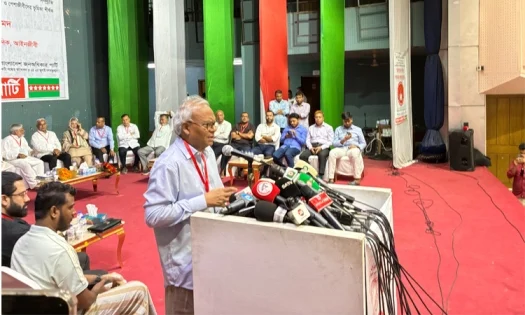
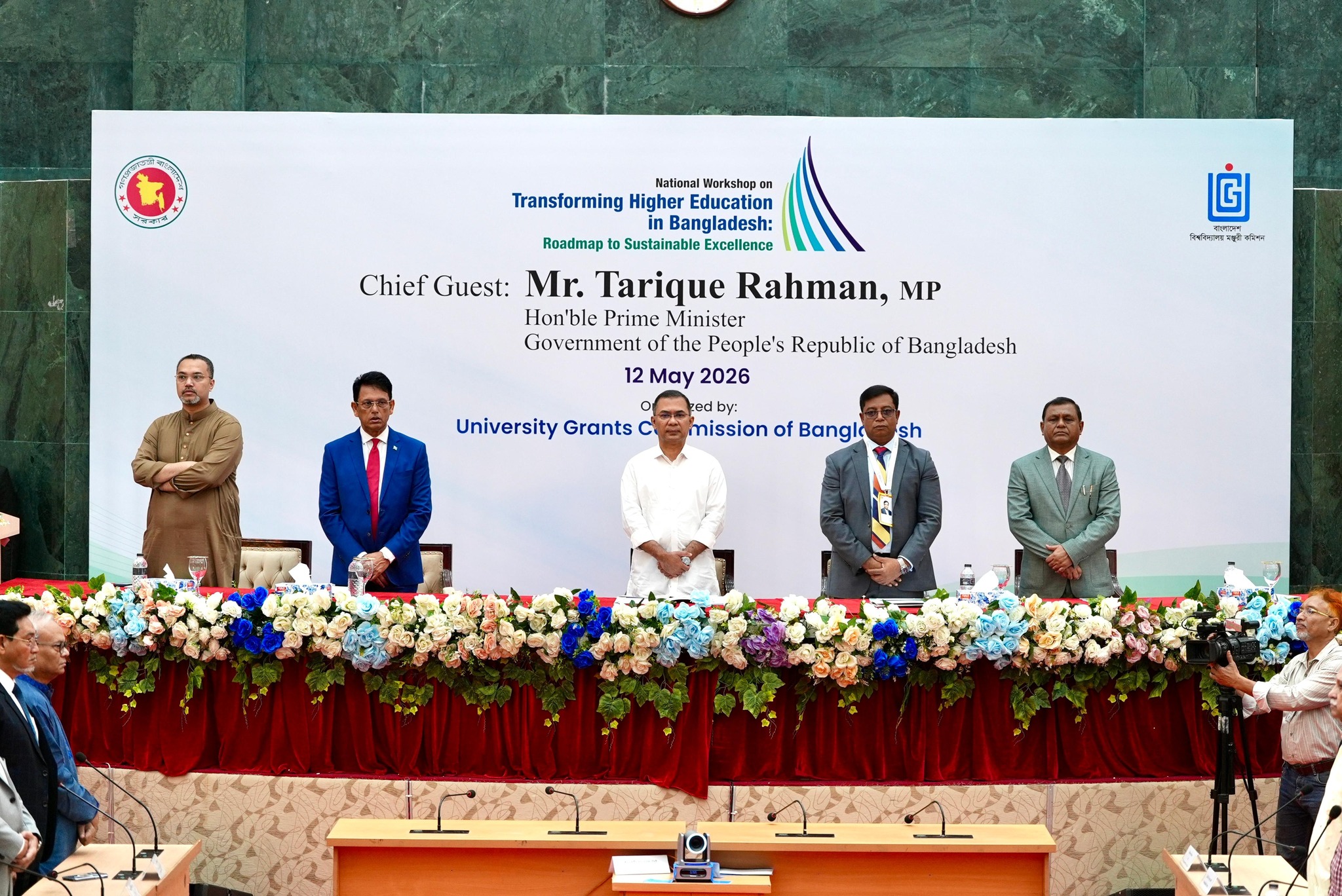
Tarique Rahman, also ruling BNP chairman, made the remarks while addressing the inaugural session of a daylong national workshop at Nabab Nawab Ali Chowdhury Senate Bhaban in Dhaka University (DU) in the capital yesterday morning.
The University Grants Commission (UGC) organized the workshop titled “Transforming Higher Educa-tion in Bangladesh: Roadmap to Sustainable Excellence” with the aim of making the country’s higher education system more modern, inclusive and sustainable.
Stating that the world has now entered the Fourth Industrial Revolution, the Prime Minister said, “In this era of the Fourth Industrial Revolution, the advanced technologies like artificial intelligence, robotics and automation, Internet of Things, genetic engineering, biotechnology, cyber-security, quantum compu-ting, industrial, big data, material science, nanotechnology and fifth-generation wireless technology, are on the one hand controlling our world of thought. On the other hand, they are ruling people’s workplace or employment.”
As a result, he said, the use of new technologies is on the one hand increasing unemployment in the tra-ditional job market and on the other hand creating new employment opportunities.
“To meet the challenges of the Fourth Industrial Revolution and enter new job markets, we must move away from a memorization-based and certificate-focused education system. We have to reshape our tra-ditional education system according to the demands of the Fourth Industrial Revolution,” Tarique Rah-man said.
He emphasized that in the current world, technology based education is not only essential for personal development, but also a key driver of economic growth, innovation, and international competitiveness.
Thus, the premier stressed the need for stronger collaboration between universities and the industrial sec-tor, saying the demands of the industrial sector must be incorporated in curriculum formulation.
Noting that in the current world, education is no longer confined within schools, colleges, or universi-ties, he said, “Today, the practice of knowledge is not limited to a specific subject. Rather, we see the combination of data science with biology, or engineering with sociology. Therefore, the boundaries of knowledge are constantly expanding and being dynamic. It is important for us to stay closely connected to the nature of this pace of change”.
Quoting British author Tom Goodwin, he said, “I think a famous comment by British author Tom Goodwin, who is known as a ‘business strategist and analyst’ especially in the digital world, is quite rel-evant to the content of today’s workshop”.
“However, I know that in many countries around the world, including Britain, many of the university alumni sponsor the university’s ‘research and innovation’ activities. That’s why many people say, ‘stu-dents are the lifeblood of the university, and alumni are its backbone’,” he added.