



































A Correspondent:
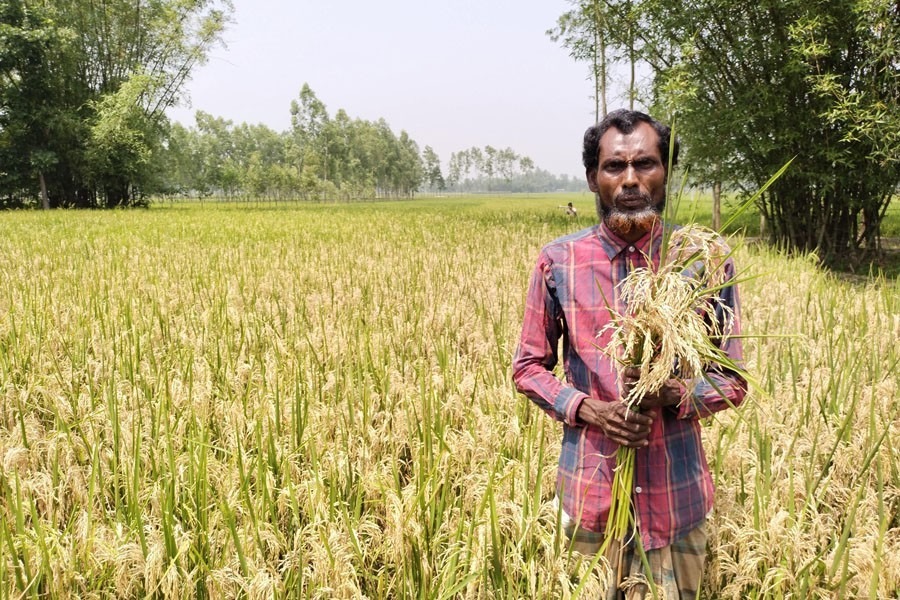
Sunamganj: The farmers in Sunamganj’s Tahirpur upazila are facing great distress due to an outbreak of the blast disease, a common fungal infection that has severely impacted their harvest during the cultiva-tion season.
The disease has been widespread in Bri-28 and Bri-81 rice varieties, leading to significant losses for farmers in the Haor Par region.
This year, paddy was cultivated on approximately 18,600 hectares of land in 23 small and large haors of the upazila, with high yielding paddy being predominantly cultivated.
The Department of Agriculture has reported that the spread of the disease in Bri-28 paddy is due to the temperature, which is hot during the day and cold at night.
As a result, farmers such as Nilu Das, who harvested paddy on 11 hectares of land in Matian Haor Par, have had to deal with a loss of yield in their Bri-28 paddy.
Similarly, Abul Kashem, a tenant farmer from Surjergaon, has lost crops from the Bri-81 paddy culti-vated on 6 hectares of land.
White to grey-green lesions can be seen in the sheaf of paddy when it’s time to be ripened, they said.
Despite the farmers spraying fungicides on the Agriculture Department’s advice, there has been little im-provement.
Asaduzzaman, the Upazila Deputy Assistant Plant Conservation Officer, said they have given advice to a lot of farmers, and some of them have benefited while others haven’t.
Hasan-ud-Daula, Tahirpur Upazila Agriculture Officer, said they have advised the farmers not to harvest Bri-28.
“But in many cases, farmers didn’t follow it (advice). Our Sub-Assistant Agriculture Officers keep farmers informed and provide guidance.,” he said.
Suprabhat Chakma, the UNO of Tahirpur upazila, has witnessed the blast disease affecting some agricul-tural lands in Haors/ssk and has directed the agriculture officer to take necessary action.
Blast disease, also known as rice rotten neck, is a fungal infection that can affect all above-ground parts of a rice plant, including the leaf, collar, node, neck, panicle parts, and sometimes the leaf sheath. The initial signs of the disease are white to gray-green lesions or spots with dark green borders.