




























Staff Reporter:
The government has launched a fresh initiative to revive the financially struggling Madhyapara Granite Mining Company Ltd (MGMCL) by giving priority to its locally produced stone in public development projects.
The decision, taken at a high-level meeting at the Prime Minister’s Office on 3 August, directs government agencies to prioritise the use of Madhyapara stone in infrastructure projects. Officials believe the move will help clear the mine’s growing stockpile of unsold stone and improve its financial performance.
Representatives from the ministries of finance, road transport and bridges, shipping, railways, water resources, and housing and public works attended the meeting.
Following the government’s directive, Madhyapara Granite Mining Company has signed two memorandums of understanding (MoUs) with the eastern and western zones of Bangladesh Railway to supply 202,513 tonnes of railway ballast.
Company officials said 144,966 tonnes had already been delivered by June this year, while discussions are continuing to expand supplies to other railway projects across the country.
BWDB to Include Madhyapara Stone in New Projects
The Bangladesh Water Development Board (BWDB) has instructed its regional offices to incorporate Madhyapara stone into the design and cost estimates of new development projects.
The directive also covers repair, maintenance and rehabilitation works.
Madhyapara stone is already being used in riverbank protection projects in Chapainawabganj, Kurigram, Thakurgaon, Pabna and Sirajganj, with authorities planning to expand its use in erosion control schemes nationwide.
Meanwhile, the Ministry of Housing and Public Works has initiated the process of including Madhyapara stone in the government’s official schedule of rates. Discussions are also underway to make the use of locally produced stone mandatory in tenders for government-funded projects.
Unsold Stock Has Weighed Heavily on Mine
Managing Director Amjad Hossain said Bangladesh Railway and river management projects were the mine’s principal customers when commercial production began.
However, although demand for stone increased significantly in the construction sector, the company’s production and marketing strategies failed to adapt to changing market conditions.
At the same time, the Water Development Board shifted towards using geobags and concrete blocks in many projects, while railway contractors increasingly opted for cheaper imported stone, leaving large quantities of Madhyapara stone unsold.
“Bangladesh Railway and the Water Development Board have recently resumed using Madhyapara stone,” Hossain said.
“If the government’s purchasing directive is fully implemented, the existing stockpile will gradually be cleared, easing the company’s liquidity crisis.”
Board Chairman Calls for Tax Reform
Chairman of the company’s Board of Directors, Professor Dr M Shamsul Alam, welcomed the government’s initiative, saying mandatory use of Madhyapara stone in public projects would help secure the mine’s long-term future.
He noted that the company currently meets only 5-6% of Bangladesh’s annual stone demand, while lower-priced imported stone continues to dominate the market.
Shamsul Alam also urged the government to review existing tax and VAT policies, arguing that high taxation has significantly increased the production cost of locally mined stone.
“Tax and VAT policies should be reassessed in the national interest so there is scope to reduce the price of domestically produced stone,” he said.
“As a state-owned enterprise, ensuring sustainable operations should take precedence over maximising profits.”
Financial Losses Persist Despite Strong Production
Bangladesh’s annual demand for stone is estimated at 21.6 million tonnes, whereas Madhyapara has an annual production capacity of 1.0 to 1.3 million tonnes.
According to the company’s June progress report, it produced 1.3 million tonnes of stone during the 2025-26 fiscal year, selling 1.05 million tonnes and generating approximately Tk306 crore in revenue.
However, total expenditure reached Tk442 crore, resulting in an operating deficit of Tk136 crore and a net loss of Tk124 crore after tax.
Production was also disrupted for one month and 22 days during the fiscal year due to a shortage of ammonium nitrate explosives, company sources said.
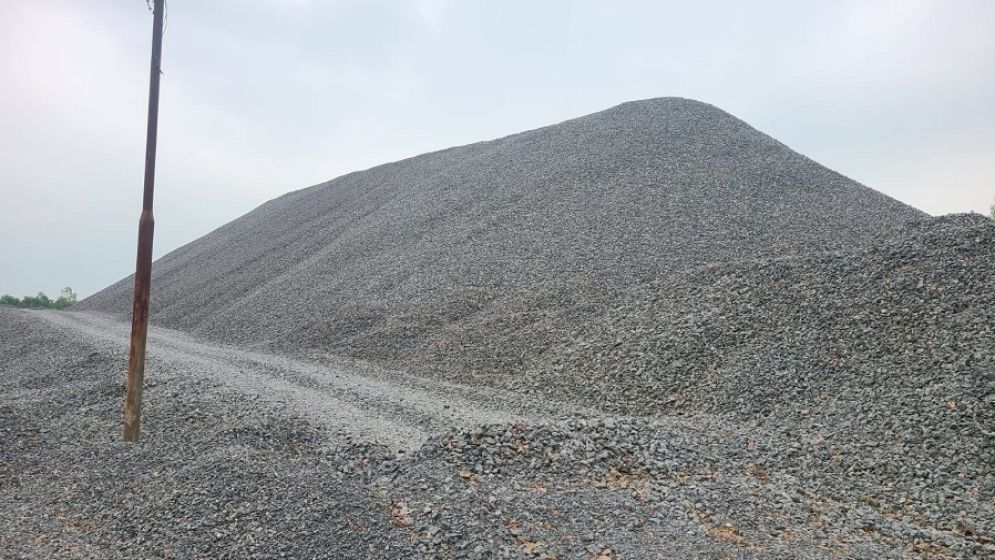
The mine currently holds approximately 1.38 million tonnes of unsold stone, comprising around 880,000 tonnes of railway ballast, 390,000 tonnes of boulders, and 102,000 tonnes of stone dust.
Officials expect the government’s latest procurement policy to gradually reduce the stockpile, improve cash flow and help return the long loss-making state-owned enterprise to financial stability while strengthening Bangladesh’s use of domestically produced construction materials.