














Staff Reporter:
The July uprising that swept across Bangladesh did more than bring down a government; it fundamentally reshaped the identity of the country’s madrasah students, who suffered some of the heaviest casualties after joining the front lines of the movement alongside mainstream youth.
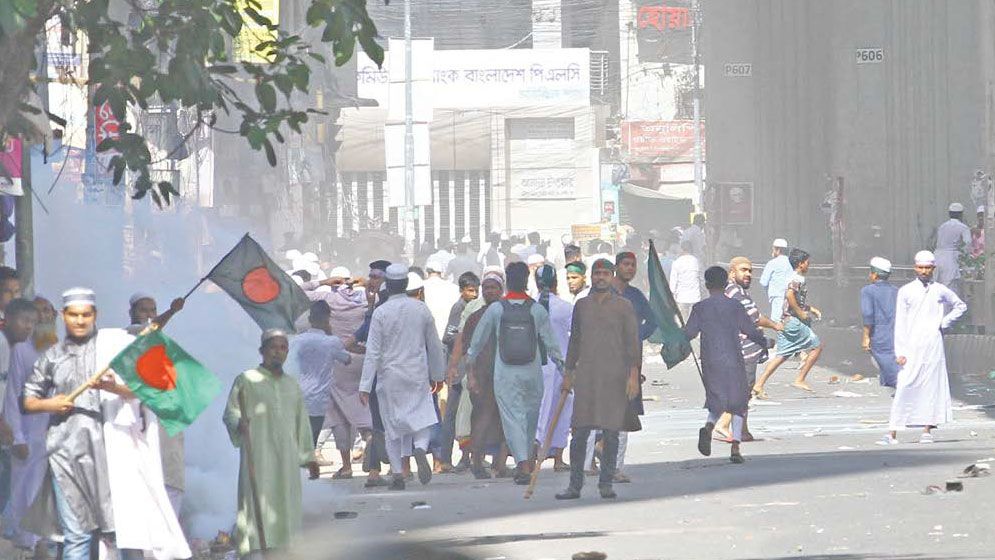
Long marginalized by public stereotypes, madrasah students became pivotal figures in resistance hubs like Jatrabari – the fierce eastern Dhaka battleground dubbed the movement’s “Stalingrad”. Yet behind the collective statistics lies a trail of quiet parental heartbreak.
“I told my only son not to join the movement because I feared losing him,” recalled Syed Md Gaziur Rahman, his voice trembling. “But Alif had only one answer: ‘Even if I die, I must go. Our elder brothers are sacrificing their lives – I cannot stay at home.’”
Around midnight on 5 August, Gaziur identified the body of his son, Syed Muntasir Rahman Alif, outside the Dhaka Medical College Hospital morgue by his white pyjamas and black T-shirt. An Alim student at Tamirul Millat Kamil Madrasah, Alif had slipped out after his English class to join the demonstrations.
He was far from alone.
At least 85 madrasah students were killed nationwide during the uprising, according to a Daily Sun analysis of data from ‘Sadharon Alem Shomaj’, an organisation of young Islamic scholars.
The peak of the violence came on 5 August, when roughly 30 madrasah students died, following 22 fatalities on 19 July. Greater Dhaka accounted for 67 deaths, including 11 in Jatrabari.
The support effort was equally widespread. Despite campus restrictions, female madrasah students played a vital role;
in Jatrabari, students from Sontek Mohila Madrasah regularly cooked and delivered meals to field protesters.
For survivors, the movement shattered longstanding public perceptions. Mustaeen Billah Habibi, an injured student from Jamia Arabia Imdadul Uloom, noted that madrasah students were historically painted as anti-progress or linked to extremism.
“July changed everything,” Habibi said. “When ordinary citizens stood shoulder-to-shoulder with us, it proved the public still respects Islamic scholars despite years of hostile narrative building.”
In Khulna, Mujahidul Islam of Charmonai Ahsanabad Jamia Rashidia Islamia said his religious studies actively drove his civic responsibility: “Madrasah education teaches morality, discipline, and duty. Those values compelled us to stand up for justice.”
The uprising also disproved claims that madrasah students operate solely under the orders of their teachers or muhtamims.
Maksudur Rahman Junayed, member secretary of ‘Boishommobirodhi Qawmi Chhatra Andolon’, emphasised that the turnout was organic and self-directed.
Despite strict campus bans on mobile phones, students monitored the crackdown via social media and word of mouth, with viral videos of police violence acting as a catalyst.
With senior scholars wary after years of state pressure under the fascist Awami League administration, the youth took matters into their own hands, often leaving campus grounds in secret. “Teachers didn’t issue commands to march,” Junayed said. “The students made up their own minds and stepped onto the streets to defend the nation.”