

































Commerce reporter:
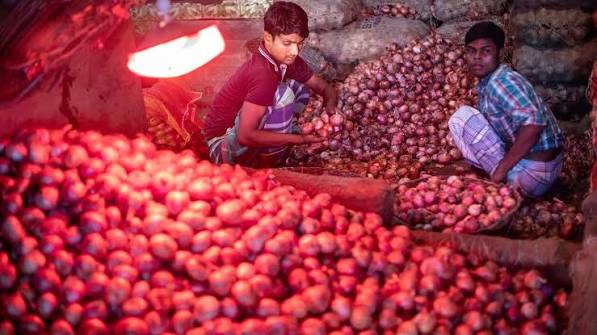
Bangladesh has achieved self-reliance in onion production, with a significant increase in domestic output and improved storage facilities ensuring an uninterrupted supply of the essential kitchen commodity in local markets, particularly during the off-season.
The country produced a record 50.90 lakh tonnes of onions this year against an annual demand of around 36 lakh tonnes, exceeding domestic requirements by 41.39 percent, officials said.
At the same time, the introduction of modern storage facilities at the farmers’ level has strengthened the country’s capacity to preserve onions and ensure their availability at affordable prices throughout the year.
The improved storage system has also helped reduce post-harvest losses, which traditionally range between 20 and 30 percent and can reach 50 percent or more during severe rotting or unfavourable weather conditions.
Such losses usually create a supply shortage between September and December, pushing up prices and increasing the country’s dependence on imports.
The increased production, coupled with the distribution of modern air-flow machines among farmers, has enabled Bangladesh to suspend onion imports for the past 11 months.
The country has also saved approximately US$382 million, equivalent to more than Tk 4,764 crore, by reducing its dependence on imported onions, which were traditionally needed mainly during the September-December period when domestic stocks began to run out.
According to the Department of Agricultural Extension (DAE), Bangladesh imported 4.73 lakh tonnes of onions in fiscal year 2024-25 against domestic production of 44.48 lakh tonnes. Imports had reached nearly six lakh tonnes in 2023-24, when production stood at 39 lakh tonnes.
“Onion imports are no longer necessary for us. We have already developed modern storage facilities with a capacity of around four to five lakh tonnes, which are sufficient to address the annual supply shortage during the off-season. There is no possibility of an onion shortage throughout the year,” said DAE Director General M Abdur Rahim.
He said a total of 26,700 air-flow machines had so far been distributed among farmers, while the government plans to provide another 4,000 machines under its farmers’ incentive programme in the current fiscal year.
Explaining the profitability of onion cultivation, the DAE chief said farmers were now producing around 100 maunds of onions per bigha of land and earning approximately Tk 1 lakh by spending around Tk 50,000 on cultivation.
“This makes onion a profitable crop, and farmers will be encouraged to continue cultivation for their own benefit,” he added.
M Nasir Mia, a farmer from Nadia village in Madhukhali upazila of Faridpur district, said he had preserved 145 maunds of onions using an air-flow machine for the past six months.
He said the technology had significantly reduced storage losses compared to conventional methods.
Another farmer, Mohammad Amin of Fakirpara village in Godagari upazila of Rajshahi district, said modern storage facilities had helped farmers secure better prices.
He said the price of onions, which remained between Tk 800 and Tk 1,000 per maund immediately after the April harvest, increased to Tk 1,600-1,700 during September-December.
However, farmer Jahangir Mia of Chandidasdi village in Banga upazila of Faridpur district stressed the need for the government to explore onion export opportunities to ensure better returns for growers.
Meanwhile, the DAE stopped issuing import permits (IPs) for onions in December 2025. Consequently, no onions were imported during the current calendar year, while only 86,368 tonnes were imported between August and December of fiscal year 2025-26.
The country’s onion production reached 50.90 lakh tonnes this year from more than three lakh hectares of land, representing an increase of around seven to 10 lakh tonnes compared to the previous year.
Production per bigha also increased to around 100 maunds from the previous average of 70 maunds, supported by favourable market prices of Tk 2,000-4,500 per maund (37.32 kg) last year and substantial rainfall in late March, about two weeks before harvesting.
Speaking to media, Dr Mahfuzur Rahman, project director of the “Adaptation Project on Onion Storage at Farmers’ Level based on Partnership to Mitigate the Adverse Effects of Climate Change in Onion Growing Areas of Bangladesh”, said increased production and improved storage technology had significantly reduced the country’s dependence on imported onions.
Under the project, Tk 27,000 has been provided to each beneficiary farmer through bank accounts. Of the amount, Tk 19,000 is allocated for purchasing an air-flow machine, Tk 7,000 for constructing a platform and Tk 1,000 for a signboard at the farmer’s residence.
The technology has enabled farmers to store around three lakh tonnes of onions, with each machine having a storage capacity of approximately 10 tonnes.
The project has been implemented in 107 upazilas across 16 districts, including Pabna, Faridpur, Rajbari, Rajshahi, Kushtia, Magura, Jhenaidah, Manikganj, Natore, Naogaon, Meherpur, Chapainawabganj, Madaripur, Shariatpur, Rangpur and Bogura.
Besides, around 3,900 farmers are receiving technical training under the project.
Dr Mahfuz said the government had extended the technology to 50,000 farmers through public and private initiatives, while the country has approximately two lakh onion growers in 17 onion-producing districts.
To increase the production of summer onions, locally known as murikata, the government is also extending the second phase of the Extension of Improved Variety and Technology of Spices Project (EIVTSP) until 2031.
The programme will cover 110 upazilas and 25 horticulture centres across 40 districts.
An earlier five-year project, involving an allocation of Tk 137.42 crore, is scheduled to continue until June 2027.
Dr Mahfuzur Rahman said a total of 3,375 summer onion demonstration plots would be established during the project period.