











Staff Reporter:
With shock and sorrow a human sea yesterday bade the last farewell to their popular leader, beloved former prime minister and BNP chairperson Begum Khaleda Zia.
The people of the country plunged into a deep grief as the three-time former prime minister, widely re-garded as an uncompromising leader for democracy in Bangladesh, was laid to eternal rest beside her husband Shaheed President Ziaur Rahman’s grave in capital Dhaka with a shower of love, respect and reverence.
The country witnessed an unprecedented love for a leader as millions of mourners from across the coun-try converged Manik Mia Avenue and surrounding areas spanning a radius of several kilometers to pay their final tributes to the first female prime minister of Bangladesh.
All roads led to her burial site with millions of people making a human sea as people traveled from eve-ry hook and corner of the country by buses, trains, launches, metro rail and other transports. Scenes of deep sorrow were visible with thousands of mourners weeping openly.
The influx of BNP leaders and supporters into the capital intensified following the spread of news of Begum Zia’s death. Continuous streams of people arrived from different regions of the country. Authori-ties struggled to manage the massive crowd as the capital became the focal point of national mourning.
Defying severe cold, leaders, activists and ordinary citizens began gathering at Manik Mia Avenue and surrounding areas from Tuesday night. By early Wednesday morning, the Jatiya Sangsad Bhaban com-plex, nearby roads and pavements were filled to capacity. Many spent the night outdoors to secure a place near the funeral venue, holding national flags, party banners and portraits of Begum Zia.
World leaders were also joined in final tribute to Khaleda Zia as foreign leaders, envoys and heads of international organizations gathered in Dhaka to honor the legacy of the veteran Bangladeshi stateswom-an showing an extraordinary global and regional outpouring of respect.
The presence of foreign dignitaries transformed the solemn ceremony into a moment of shared mourning and diplomatic tribute, reflecting Begum Khaleda Zia’s enduring stature on the regional and international stage.
Among those present were- Sardar Ayaz Sadiq, Speaker of the National Assembly of Pakistan, Dr. S. Jaishankar, External Affairs Minister of India, D.N. Dhungyel, Foreign Minister of Bhutan, Bala Nanda Sharma, Foreign Minister of Nepal. Vijitha Herath, Minister of Foreign Affairs, Foreign Employment and Tourism of Sri Lanka; and Dr. Ali Haidar Ahmed, Minister of Higher Education, Labour and Skills Development of the Republic of Maldives.
The foreign guests paid their final respects and conveyed condolences to the bereaved family and the people of Bangladesh.
Their presence at the funeral was seen as a gesture of deep respect and a reaffirmation of longstanding diplomatic ties and friendship between Bangladesh and its neighboring and partner countries.
Being floated the people and admirers at the home and abroad in the waves of grief, the Bangladesh’s democracy icon embarked on her final journey to eternity through her burial with full state honor beside her husband grave at Zia Udyan in the capital around 4:50pm.
After the burial, a smartly turned-out contingent drawn from the Bangladesh Army, Navy, and Air Force presented a state salute with three gun-shots in honor of Begum Khaleda Zia. During that time, the bugle played the last Post.
On behalf of the President and the Chief Adviser, floral wreaths were placed at the grave of Begum Zia.
Later, BNP Acting Chairman Tarique Rahman and chiefs of the three services placed wreaths at her grave.
Khaleda Zia’s family members, several advisers of the interim government, BNP Secretary General Mir-za Fakhrul Islam Alamgir, Standing Committee members and other senior leaders attended the burial rituals.
After the burial, doa and munajat were offered seeking the eternal peace of the departed soul.
Khaleda Zia’s body was taken into the grave around 4:30 and the burial ritual was completed around 4:50pm.
During the burial, Begum Zia’s family members, including Tarique Rahman, his wife, daughter, Arafat Rahman Koko’s wife and daughters stood in solemn silence.
Earlier, millions of people joined her namaz-e-janaza at the Manik Mia Avenue around 3pm. Baitul Mukarram National Mosque Khatib Mufti Mohammad Abdul Malek conducted the funeral prayers while BNP Standing Committee Member Nazrul Islam Khan read out a brief biography of Begum Zia.
Chief Adviser Professor Muhammad Yunus, Chief Justice Zubayer Rahman Chowdhury, and Khaleda Zia’s son and BNP Acting Chairman Tarique Rahman joined the funeral prayers along with foreign dig-nitaries, advisers of the interim government, leaders of different political parties and senior government and military officials.
Tarique Rahman sought doa (supplication) for eternal peace of the departed soul of his mother saying: “I am Tarique Rahman, elder son of late Begum Khaleda Zia . . . please pray for my mother so that Allah grant her the Jannat”.
The Janaza began around 3:00 pm while the coffin wrapped in the national flag was brought to the ven-ue around 2:45 pm with full state honour.
People from all walks of life offered prayers seeking forgiveness for the departed soul of Begum Zia as they burst into tears being emotional with the passage of their beloved leader.
Mourners including farmers, students, teachers, government employees and political activists described Begum Zia as a guardian of the nation and a symbol of democratic resistance.
BNP Secretary General Mirza Fakhrul Islam Alamgir urged leaders and supporters to maintain disci-pline, calling the farewell a moment of national mourning.
Earlier, the body of Khaleda Zia was taken to her son Tarique Rahman’s residence from Evercare hospi-tal with state protocol.
Tarique Rahman recited from the Holy Quran sitting beside his mother’s coffin at that time and offered prayer for eternal peace of her departed soul. Then her body was taken to the South Plaza of Jataya Sangsad Bhaban.
The entire area was teamed up with mourners as her body carrying mortuary van wrapped with the na-tional flag reached the Manik Mia Avenue.
Following the janaza, Begum Khaleda Zia’s body was taken to Zia Udyan at Sher-e-Bangla Nagar for burial.
Begum Khaleda Zia, Bangladesh’s first female Prime Minister, passed away at 6:00 am on Tuesday at the age of 80 while undergoing treatment at Evercare Hospital in Dhaka.
Elected Prime Minister for the first time in 1991 through a popular vote, she played a crucial role in country’s transition to parliamentary democracy and introducing election-time the caretaker government system.
She is survived by her elder son Tarique Rahman, two daughters-in-law and three grandchildren. Her younger son Arafat Rahman Koko died in 2015.
The interim government has declared three days of state mourning from Wednesday to Friday in honour of the late leader.
The national flag has been kept at half-mast at all government, semi-government, autonomous institu-tions, educational institutions, all public and private buildings, as well as at Bangladesh missions abroad.
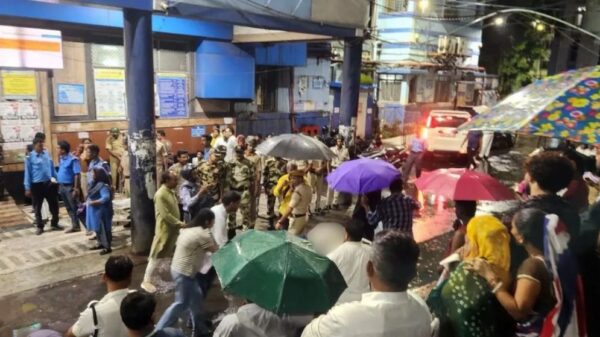
Law enforcement agencies tightened security across the area, deploying medical teams, ambulances, wa-ter distribution points and temporary shelters for people bound to Khaleda Zia’s burial program.
Metro rail stations saw heavy congestion while additional MRT Police were deployed at key stations. The authorities said the overall situation remained under control.
BNP is observing seven days of mourning following the death of party chairperson Khaleda Zia.
As part of the program, black flags were hoisted at all BNP offices across the country for seven days. Leaders and activists at all levels of the party wore black badges during the mourning period. Prayers will be held at every party office.
Condolence books have been opened at the BNP offices, including the party chairperson’s office in Gul-shan, the central office at Nayapaltan, and district-level offices, where political leaders and well-wishers wrote messages paying tribute.
Khaleda Zia had been suffering from multiple health complications, including heart and lung, liver and kidney, diabetes, arthritis and eye-related ailments. She had a permanent pacemaker in chest and previ-ously underwent stenting in her heart.
She was admitted to Evercare Hospital on November 23 following the advice of her medical board after being diagnosed with infections in her heart and lungs. She had also been suffering from pneumonia.