






























A Correspondent:
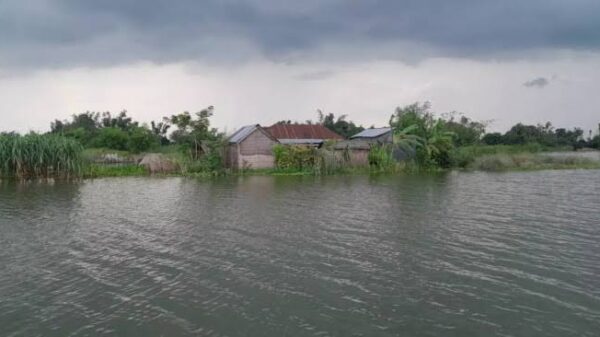
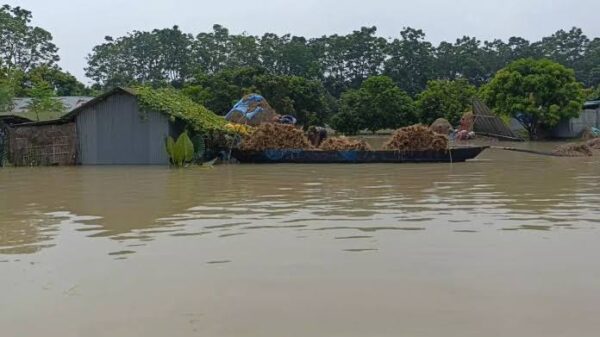
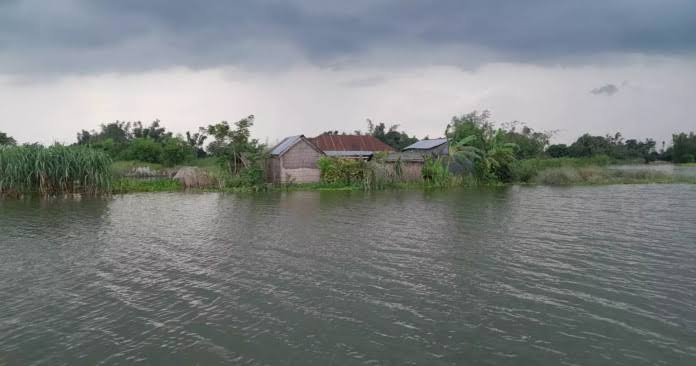
Kushtia: The water level of the Padma River in Daulatpur upazila has continued to rise, leaving around 60,000 people stranded in 35 villages in the char areas of Ramkrishnapur and Chilmari un-ions.
The river rose by 3 centimeters in the past 24 hours and was flowing just 75 centimeters below the danger level at the Hardinge Bridge point on Saturday morning.
According to the Hydrology Division of the Pabna Water Development Board (PWDB), the water level was recorded at 13.05 meters at 9:00am on Saturday, against the danger level of 13.80 meters. It was 13.02 meters at the same time on Friday.
The water level had been rising by around 10 to 12 centimeters a day over the past week. However, the rate of increase slowed considerably in the past 24 hours.
Ilias Hossain, executive engineer of the PWDB Hydrology Division, said the rise was caused by heavy rainfall and an influx of upstream water.
“However, the rate of increase slowed to 3 centimeters in the last 24 hours. It is too early to say whether the water level will continue to rise,” he said.
Floodwaters have inundated large areas of Ramkrishnapur and Chilmari unions, as well as low-lying char areas of Philipnagar Union, disrupting road communication.
Abdul Mannan, Chairman of Chilmari Union Parishad, said 17 of the union’s 19 villages have been flooded, leaving around 30,000 people stranded.
He said the situation on Saturday was slightly better than during the previous two or three days as the rate of water-level rise had slowed.
Ramkrishnapur Union Parishad Chairman Siraj Mondal said all 16 villages in the union were sur-rounded by floodwater, with roads submerged and boats and makeshift rafts becoming the only means of transport.
More than 30,000 people are stranded in the union, he said.
Upazila Agriculture Officer Rehena Parveen said around 351 hectares of farmland in Chilmari, Ramkrishnapur, Philipnagar and Moricha unions have already been submerged.
Chilli and banana growers have suffered the heaviest losses, she said, warning that the damage could increase if the water level continues to rise.
Meanwhile, classes have been suspended at 25 government primary schools and three secondary schools in the char areas due to the flooding. Administrative activities at the institutions, however, remain operational, according to the Upazila Education Office.
The flooding has also submerged cooking areas and tube wells, causing shortages of food and safe drinking water. Farmers and livestock owners are struggling to protect and feed their animals.
Abu Biswas, 65, of Ramkrishnapur, said floodwater had risen to waist level inside his home.
“Other members of my family have moved to higher ground. I am somehow staying on a makeshift raised platform,” he said.
Julekha Khatun of Char Sonatala said floodwater was flowing through her home after the road col-lapsed.
“Cooking has stopped. I am struggling to arrange meals for my family,” she said.
Shymol Mondal said five bighas of his chilli crop had gone underwater.
“Movement has become extremely difficult. The elderly members of my family are confined in-doors, and we are having to make one meal last for three sittings. We are also very afraid of snakes,” he said.
Locals said the presence of venomous snakes has increased in the flooded char areas, raising con-cerns over public safety.
They have called for urgent supplies of dry food and safe drinking water, as well as the deployment of mobile medical teams.
Dr Touhidul Hasan Tuhin, upazila health and family planning officer, said the Upazila Health Complex has sufficient stocks of anti-venom.
“We are advising people not to waste time going to traditional healers after a snake bite. They should take the patient to hospital immediately,” he said.