





























Staff reporter:
Commerce Minister Khandakar Abdul Muktadir yesterday stressed the need for modern packaging, effective quality control and joint initiatives with the European Union (EU) to enhance the competitiveness and global acceptance of Bangladesh’s agricultural products.
He said Bangladesh’s agricultural export potential could be expanded further by ensuring international standards and winning the confidence of foreign buyers.
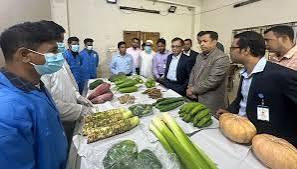
The minister made the remarks while addressing a meeting after visiting the Central Packing House, operated by the Department of Agricultural Extension (DAE), at Shyampur in the capital, said a press release.
Emphasising agricultural modernisation and higher productivity, he said crop production should be based on scientific methods and precise information about soil quality and nutrient levels.
He said identifying deficiencies in essential soil nutrients, including phosphorus, zinc, calcium and magnesium, and applying fertilisers and other inputs accordingly could significantly increase agricultural productivity.
The minister directed the concerned authorities to prepare soil maps based on the quality and nutrient composition of land in different parts of the country.
He also stressed identifying suitable crops for different regions and seasons and providing farmers with necessary technical advice.
Highlighting the importance of building foreign buyers’ confidence, Muktadir said Bangladesh needs to establish a reliable position for its agricultural products in international markets.
He said coordinated and collaborative initiatives with the EU, alongside strengthening domestic capacity, could create greater opportunities for entering new markets and expanding existing ones.
The minister also underscored the need to strengthen the institutional and technical capacity of the Central Packing House to ensure international standards in agricultural and processed agricultural exports.
According to the export report presented at the meeting, a total of 5,257.41 tonnes of agricultural products were exported through the Central Packing House in fiscal year 2025-26, compared to 4,155.49 tonnes in the previous fiscal year, marking a growth of around 26.5 percent.
Of the total exports, fresh fruits accounted for 3,105.99 tonnes, fresh vegetables 1,925.83 tonnes, and spices and other agricultural products 225.59 tonnes.
Mangoes, jackfruits and citrus fruits were among the leading exported fruits. During FY26, the country exported 1,095.99 tonnes of mangoes, 719.22 tonnes of jackfruits and 652.78 tonnes of citrus fruits.
Various vegetables and other agricultural products, including beans, bottle gourds, taro, pointed gourds, snake gourds and papayas, are also being exported to international markets.
Major export destinations include the United Kingdom, Germany, France, Italy, Portugal, Spain, Switzerland, Malta, Sweden, Ireland, Austria, Belgium and Greece.
The Central Packing House has also made significant progress in ensuring compliance with international export standards.
According to the institution, before its establishment, the EU used to issue around 120 to 170 non-compliance notifications annually over quality and standards-related shortcomings in Bangladesh’s agricultural exports.
Following the establishment of the facility, the number of such notifications declined to an average of 15 to 20 a year.
Notably, around 1,095 tonnes of mangoes were exported through 1,457 consignments after rigorous quality control, scientific testing and phytosanitary management, without receiving any non-compliance notification against those consignments.
To modernise the export certification process, the Central Packing House has been issuing fully computerised phytosanitary certificates since FY2017-18.
The facility also conducts laboratory tests on exportable plants and plant products, detects harmful pests, examines pesticide residues and ensures safe transportation of export consignments to the airport through its own locking and sealing system.
The institution has also contributed to government revenue. Between FY2021-22 and FY2025-26, it issued a total of 21,516 phytosanitary certificates and generated Tk 1.12 crore in revenue.
In FY2025-26 alone, it issued 4,504 such certificates, generating Tk 23.56 lakh in revenue.
The meeting, held at the conference room of the Central Packing House, discussed its ongoing activities, infrastructure and technical capacity, quality control, modern packaging systems and measures to meet the requirements and standards of international markets.
After the meeting, the minister visited different laboratories of the facility and talked to technicians about agricultural product testing and quality control activities.