











Staff Reporter:
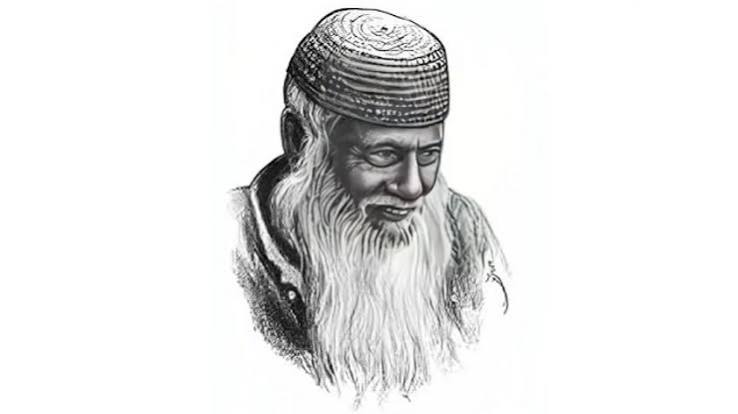
The 50th death anniversary of Maulana Abdul Hamid Khan Bhashani, a leader of the oppressed who dedicated his entire life to the struggle for the rights of the exploited, deprived and the downtrodden people, will be observed today.
Various political and social organizations have taken various programs to observe the anniversary including placing of wreaths at his grave in Santosh in Tangail, doa mahfils and discussions.
Maulana Bhashani Science and Technology University will organize various programs to observe the anniversary.
Bhashani was born on December 12, 1880, in the village of Dhangara in Sirajganj. His father was Sharafat Ali Khan and his mother was Mosammat Majiron Bibi.
Educated in religious studies, he later pursued Islamic education in Deoband in India. However, his vision and actions were never confined to the religious sphere. The irregularities within society, class-based discrimination and the deprivation faced by the common people drew him into political and social movements.
From the anti-British movement to the struggle against Pakistani rule and exploitation and from the movement for Bangladesh’s independence to the political realities of the post-independence era-at every stage, he remained a vocal advocate for the common people.
By prioritizing human rights over power, the public interest over personal gain and the pursuit of justice over compromise, this leader holds a unique place in the political history of Bangladesh.
The core strength of Maulana Bhashani’s politics lay in his deep connection with the common people. He placed the struggles of farmers, laborers, the landless and the poor at the very heart of his political agenda. For him, independence meant more than just the attainment of state sovereignty, it signified the realization of economic and social emancipation for the people.
During the era of British colonial rule, he participated in the Khilafat and Non-Cooperation movements. He was a staunch voice against the exploitation by zamindars (landlords), feudalism and the oppression of the peasantry. Notably, he played a significant role in defending the rights of Bengali farmers in Assam-securing their access to land, housing and livelihoods. He gained widespread recognition by leading a farmers movement against the ‘Line System’ in Assam. It was through his peasant movements and organizational activities in the Bhasan Char region of Assam that he came to be known as ‘Bhashani’.
Following the establishment of Pakistan in 1947, he played a pivotal leadership role in the movement to secure the political, economic and cultural rights of the people of East Pakistan. When the Awami Muslim League was founded at Rose Garden in Dhaka on June 23, 1949, he was elected as its first president.
From the very beginning, he was vocal against the discriminatory policies and economic exploitation imposed by the Pakistani ruling class, as well as their suppression of the political rights of the people of East Pakistan. He also championed the cause of the Bengali language, aligning himself with the burgeoning national consciousness of the Bengali people.
He played a crucial role in the formation of the ‘United Front’ (Jukta Front) to contest the Muslim League in the 1954 provincial elections.
The historic victory of the United Front served as a significant popular mandate in favor of the rights and autonomy of the people of East Pakistan. His organizational acumen and strong grassroots support contributed significantly to this success.
A defining chapter in his political career was the Kagmari Conference of 1957. Held in Santosh, Tangail, the conference saw him lodge a fierce protest against the disparities between the two wings of Pakistan and the hegemony of the West Pakistani ruling elite. His historic utterance of ‘Assalamu Alaikum’ at the conference is regarded as a significant moment in history, interpreted by many as a signal of the potential political separation of East Bengal.
In 1957, he founded the National Awami Party (NAP). Through this platform, he continued his struggle against imperialism and feudalism, advocating for a society free from exploitation. His political philosophy integrated religious values, social justice, equality and a deep-seated aspiration for the liberation of the oppressed. For this reason, he was also known among his followers as the ‘Red Maulana’.
During the military regime of Ayub Khan, he spearheaded movements demanding democracy and autonomy. In the mass uprising of 1969, he bolstered the struggle against military rule by extending his support to the movements led by students and the general public. He viewed the right to vote, democracy and economic emancipation as the essential prerequisites for true freedom. When the Liberation War began in 1971, he took a firm stand in favor of Bangladesh’s independence.
He played a significant role in shaping international public opinion against the genocide and atrocities committed by the Pakistani forces. During his time in India throughout the Liberation War, he was associated with the advisory council of the exile government of Bangladesh. Following independence, he returned to the country on January 22, 1972, and once again became active in advocating for the rights of the common people and demanding state accountability.
In independent Bangladesh, the core objective of his politics remained the establishment of a society free from exploitation and discrimination. By critiquing various government policies and actions, he championed the rights of the people, food security, economic equality and democratic accountability. His hunger strike in 1973, staged to demand food, served as a testament to his deep commitment to the struggles of the common people.
In the arena of international politics, he was a vocal opponent of imperialism and hegemony. He was well-known for his solidarity with oppressed peoples across the globe, including those in Palestine.
A defining moment in the final phase of Maulana Abdul Hamid Khan Bhashani’s political career was the historic Farakka Long March on May 16, 1976. He led this march-which saw massive public participation-from Rajshahi toward Kansat in Chapainawabganj, aiming to secure a fair share of the Ganges waters and to protest the adverse impacts of the Farakka Barrage. This movement focused on the equitable distribution of water from shared rivers and the interests of Bangladesh.
Bhashani passed away on November 17 in 1976 while undergoing treatment in Dhaka. Even five decades after his death, his political stance centered on the rights of farmers and laborers, fight against economic inequality, promotion of democracy and opposition to imperialism and hegemony continues to be a subject of renewed discussion.