

































Staff reporter :
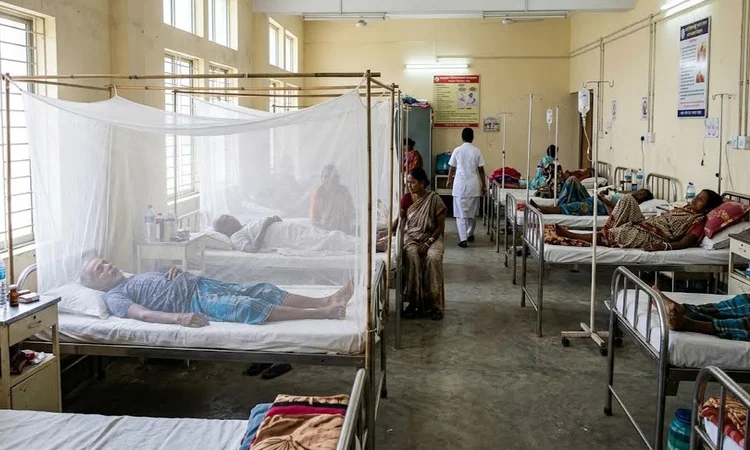
The dengue situation in the country’s coastal belt has taken a serious turn, with the number of reported cases in the coastal districts reaching over 45,000 till October 23 this year, putting growing pressure on upazila hospitals across the Khulna, Barishal and Chattogram regions.
In view of the current trend of dengue, experts stressed the need for more research to understand the disease pattern.
Over 40 per cent of all dengue patients hospitalised in the country this year up to October 23 were admitted to hospitals in 19 coastal districts.
Of the infected patients, over 34 per cent died, according to the Directorate General of Health Services (DGHS).
The affected 19 coastal districts are Cox’s Bazar, Bagerhat, Barguna, Barishal, Bhola, Chandpur, Chattogram, Feni, Gopalganj, Jashore, Jhalakathi, Khulna, Lakshmipur, Narail, Noakhali, Pirojpur, Satkhira, Shariatpur and Patuakhali.
According to the Directorate General of Health Services (DGHS), 1,512 new dengue patients were admitted to hospitals in the country in the past 24 hours, up to October 23.
On October 23, a total of 1, 18,502 dengue patients were admitted across the country. Of them, nearing 44,000 were admitted to government upazila hospitals and to private facilities in19 coastal districts. During the period, 361 patients died, and 1,12,111 patients were released from the hospital.
Meanwhile, 206 new patients were admitted in the Khulna division, and no deaths were recorded in the last 24 hours.
Since January 1, a total of 18,734 dengue patients have been reported in the division, while 17,112 have recovered and returned home.
Researchers, entomologists, physicians and public health experts have pointed to several possible factors, including the spread of the virus into the coastal areas with limited previous exposure, water storage due to shortages of safe drinking water, poor drainage and sanitation, and environmental conditions favourable for mosquito breeding.
In 2023, coastal districts accounted for 97,552 of the country’s 321,179 dengue patients, or 30.4 per cent.
Last year, 35,511 patients were hospitalised in the 19 districts out of a national total of 102,358, representing about 34.7 per cent. The figure for 2025 covers the entire year, while this year’s data are available only up to mid-October.
Talking to BSS, Dr Banga Kamal Basu, Professor of Surgery (PHD), Gazi Medical College Hospital of Khulna and a medico-social researcher, suspected it’s not only spreading from mosquitoes, emphasising more research to find out the pattern.
Emphasising more researches on dengue, he said the pattern of dengue may have changed and therefore, the system of pathological test should be changed too.
Dr Basu, also a public health specialist, stressed the need to set up epidemical disease isolated hospital in each district across the country.
Dr Tanmoy Mallick, resident medical officer at Dacope Upazila Health Complex, in Khulna, told BSS that coastal residents were generally less aware of dengue than urban populations, where the disease had been prevalent for years.
He said relatively heavy rainfall this year had created more breeding opportunities for Aedes mosquitoes in water-filled drains, canals, ponds and other places in rural areas.
People in villages are also frequently outdoors in the early morning and evening periods when Aedes mosquitoes are active, increasing their exposure to bites, he said.
Dr Rezaul Karim, health and family planning officer at coastal Koyra Hospital, attributed the spread in the upazila partly to unhygienic surroundings and limited public awareness.
He, however, said Water scarcity is another major concern in coastal areas. Many residents store rainwater and other available water in containers because of the shortage of safe drinking water. Such containers can become breeding grounds for Aedes mosquitoes if left uncovered.
He also pointed to waterlogging in several unions of Koyra, where inadequate drainage allows water to remain stagnant for extended periods.
He said awareness campaigns were being conducted to encourage residents to maintain clean environments and prevent water from accumulating in household containers, coconut shells and cattle drinking vessels.
Experts have also identified the spread of Aedes albopictus, another dengue-transmitting mosquito species, as a possible factor.
Unlike Aedes aegypti, which is commonly associated with urban environments, Aedes albopictus can breed in vegetation, leaf axils, bamboo joints, coconut shells and other natural or artificial water-holding sites in rural and semi-urban areas.
A survey conducted by the Institute of Epidemiology, Disease Control and Research (IEDCR) in Barguna in August found Aedes larvae in 26 of 134 water-holding containers examined at homes and other establishments. The Breteau Index, which measures the number of containers containing Aedes larvae per 100 houses inspected, stood at 53.06. A reading above 20 is generally considered a warning of a high risk of transmission.
The survey identified water shortages, limited access to deep groundwater, household rainwater storage and a lack of awareness about mosquito breeding sites as possible contributors.
The Barguna survey found that around 58 per cent of the Aedes mosquitoes identified were Aedes albopictus, while 42 per cent were Aedes aegypti.
Entomologist Dr Kabirul Bashar, Professor of the Zoology Department of Jahangirnagar University, told BSS that the commonly cited estimates of the relative roles of the two species in dengue transmission were largely based on findings from other countries. Their behaviour and contribution to transmission in Bangladesh might differ, making further research necessary.
“Perhaps Aedes albopictus has become capable of carrying a higher viral load. This requires detailed research,” he said.
Professor Dr Bashar, also the principal investigator of Insect Rearing and Experimental Station (IRES), said: “We are beginning research on Aedes mosquitoes.”
Director of Health Services of Khulna Division Dr Sheikh Md Mosharraf Hossain said that there was no specific programme focused on the coastal region, although dengue prevention activities were being carried out nationwide. He also said research is ongoing.
Deputy Director of Khulna Medical College Hospital (KMCH) Dr Sujat Ahmed said Aedes mosquitoes reproduce in stagnant water during and after the rainy season. The mosquitoes, which earlier mainly bit people during the daytime, now appeared to be biting both during the day and at night, he added.
Meanwhile, the government and other agencies have intensified mosquito-control operations, including insecticide spraying in the coastal belt as well as across the country, he added.
Experts suggested that the rising number of infections and deaths underscores the need for further research into the factors driving transmission in coastal districts, alongside improved drainage, safer water storage, mosquito surveillance and public awareness campaigns tailored to local conditions.