























A Correspondent:
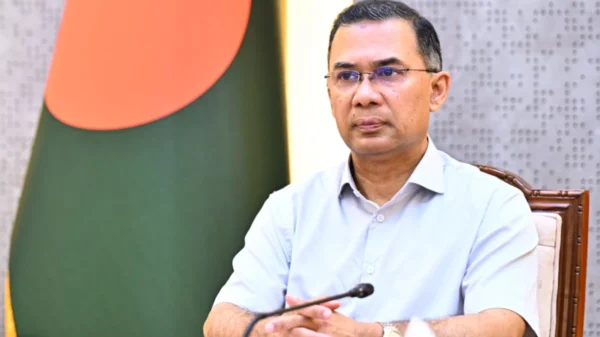
Dalian, China: Prime Minister Tarique Rahman yesterday called upon the world leaders to deliver on their commitments for the millions whose lives are at stake due to climate change.
“It is time to turn climate pledges into actions, and commitments into results, so that the world can em-brace the future with confidence. We hope COP31 will rise to this challenge, and Bangladesh stands ready to play its part,” he said.
The Prime Minister said this in his opening remarks at a session titled “Climate Leadership in a Shifting Global Landscape” at the World Economic Forum’s (WEF) 17th Annual Meeting of the New Champions here at Dalian International Conference Center.
He underscored that COP31, the upcoming 31st session of the United Nations Climate Change Confer-ence to be held in Turkey in November next, should reaffirm the goals and spirit of the United Nations Framework Convention on Climate Change (UNFCCC) and the Paris Agreement.
In this regard, he said, the WEF provides a valuable platform to foster dialogue, build consensus, and encourage collective action.
Tarique Rahman said Bangladesh believes that climate action is not a cost. “We see this as a much-needed investment for prosperity, stability, and shared future. Together we all here can build a future that is greener, safer, more sustainable, and more just,” he added.
Noting that climate resilience cannot be built by any country alone, the Prime Minister said it requires partnership, technology, finance, and shared commitment.
“As we look ahead to COP31 and COP32, we wish to emphasize three priorities,” he said.
“First, the Loss and Damage Fund must move from promise to delivery, with accessible and predictable support for victim nations. Second, climate finance must become more accessible, concessional, and re-sponsive to the needs of vulnerable countries. It should also accelerate technology transfer and private-sector investment. In this regard, we need greater mobilization and operationalization of the Green Cli-mate Fund (GCF),” Tarique Rahman said.
As the third priority, he said adaptation must stand alongside mitigation. For countries like Bangladesh, adaptation is not a policy option, it is a necessity, he added.
As pointed out by UNCTAD, the New Collective Quantified Goal (NCQG) of $300 bn falls short in meeting the mitigation and adaptation requirements for the developing countries, the Prime Minister said.
“We are here yesterday, not only as a frontline state in climate crisis, but also as a nation with aspirations to provide global solutions. We refuse to be defined by our struggle, rather we choose to be defined by our resilience,” he said.
“As outlined in our election manifesto, Bangladesh government is committed to becoming a leading cli-mate-resilient nation,” he added.
The Prime Minister said environmental protection, sustainable development, and green growth are now at the heart of Bangladesh’s nation-building strategy.
“Personally, this is also a cause I deeply care about and push for. It is about protecting lives, livelihoods, and future generations,” he said.
The Prime Minister said a national carbon market will be developed to unlock green investment and car-bon-credit opportunities.
Tarique Rahman said Bangladesh is also planning to transform waste into resources through integrated waste management, recycling, organic fertilizer production, and circular economy initiatives.
“We have already made great strides in ensuring green manufacturing. Now we can proudly say that among the top 100 LEED-certified factories in the world, 69 are from Bangladesh,” he said.