
















Staff Reporter:
Speakers at a discussion observed that while the incentives announced for the renewable energy sector in the National Budget 2026–2027 can strengthen Bangladesh’s energy security, reduce dependence on fossil fuels, and accelerate the transition toward a sustainable energy future, a clear and specific roadmap is essential to realise these objectives.
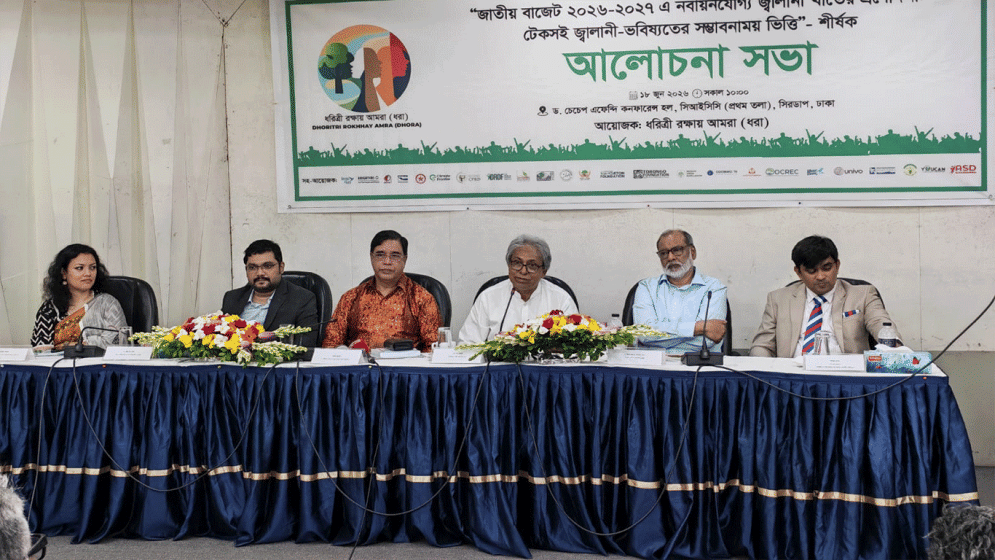
The discussion, titled “Renewable Energy Incentives in the National Budget 2026–2027: A Promising Foundation for a Sustainable Energy Future,” was organised by the environmental and climate-focused citizens’ organization DHORA (Dharitri Rokhhay Amra), said a press release.
The event was held on Thursday at the Dr Cissef Effendi Conference Hall of CIRDAP in Dhaka.
The Chief Guest was Jalal Ahmed, chairman of the Bangladesh Energy Regulatory Commission (BERC). The session was chaired by MS Siddiqui, co-convener of DHORA.
The keynote paper was presented by Shafiqul Alam, lead energy analyst at the Institute for Energy Economics and Financial Analysis (IEEFA). The event was moderated by Faisal Ahmed, member of DHORA, while the welcome address was delivered by Mir Mohammad Ali, president of the Dream Research and Development Foundation (DRDF) and associate professor at Sher-e-Bangla Agricultural University.
In his address, BERC Chairman Jalal Ahmed stated that the expansion of renewable energy is no longer only an environmental or climate necessity for Bangladesh; it has become essential for ensuring energy security, saving foreign exchange, and maintaining export competitiveness.
He noted that in order to retain access to the European Union market, Bangladesh’s ready-made garment sector must ensure a significant share of renewable energy use by 2030.
He further remarked that if the policy support and incentives proposed in the budget are implemented effectively, the country can achieve its target of generating 7,000 MW of renewable energy by 2030.
He emphasised the need for a clear roadmap, removal of policy barriers, enhanced investment support, and a shift in the mindset of government institutions to accelerate the country’s energy transition.
As Chair, MS Siddiqui remarked that promoting renewable energy requires not only government initiatives but also greater investment and innovative business models from the private sector and industrial enterprises.
He called for economic valuation of environmental benefits, removal of technological and investment barriers, and stronger engagement of youth and citizens to build a sustainable and inclusive energy future.
Presenting the keynote paper, Shafiqul noted that renewable energy currently contributes only 2.3% of Bangladesh’s electricity generation, compared to a global average of approximately 34%.
At the same time, the country’s dependence on imported energy has increased from 47.7% to 62.5%, posing a significant challenge to energy security.
He explained that the proposed duty and tax exemptions on solar panels, inverters, lithium batteries, and other renewable energy equipment in the National Budget 2026–2027 would positively contribute to sectoral growth.
These measures are expected to reduce rooftop solar installation costs by 15–20% and encourage greater adoption of solar power in industrial and commercial sectors.
Referring to experiences from Pakistan and other countries, he noted that the expansion of rooftop solar systems can effectively reduce reliance on imported energy.
He added that with appropriate policy support, investment facilitation, and effective implementation, renewable energy can significantly contribute to strengthening Bangladesh’s energy security, economic stability, and climate resilience.
However, he stressed the importance of financing under the RESCO model, participation of small entrepreneurs, quality installation and maintenance services, and a clear roadmap for Battery Energy Storage Systems (BESS).
Sharif Jamil, member secretary of DHORA, stated that Bangladesh can build a secure and renewable energy-based future if the government ensures a positive policy environment, a clear roadmap, and necessary institutional support.
He also called for rapid implementation of renewable energy projects on unused government land and increased international cooperation and investment in the sector.
Special guests included Prof Dr Mohammad Tamim, vice-chancellor of Independent University, Bangladesh (IUB); Prof Emeritus Dr Ijaz Hossain of BUET; Md Mujibur Rahman, director (renewable energy) of SREDA; Prof Dr Sakib Bin Amin of North South University; Tanzina Dilshad, programme manager (energy and environment) of the European Union Delegation to Bangladesh; and Abul Kalam Azad, coordinator of the Just Energy Transition Network Bangladesh.
The speakers highlighted the need for an investment-friendly environment, long-term policy stability, grid modernisation, investment in energy storage technologies, and the expansion of renewable energy technologies at the local level.
They also stressed the importance of making incentives more accessible for small and medium enterprises, household consumers, and local service providers.
The event brought together energy experts, researchers, academics, development practitioners, students, environmental activists, and media representatives.
It was organised by DHORA (Dharitri Rokhhay Amra). Co-organisers included Bangladesh Krishak Federation, Bengal Peace Foundation, Brighters, Brati Samaj Kallyan Sangstha, Buriganga Riverkeeper, Centre for Participatory Research and Development (CPRD), Climate Frontier, Dream Research and Development Foundation (DRDF), EquityBD, ERDA, Global Law Thinkers Society (GLTS), Mission Green Bangladesh, OAB Foundation, Organization for Climate Resilience and Environmental Conservation (OCREC), River Bangla, Sachetan Foundation, Upakul O Sundarban Surakkha Andolon, Waterkeepers Bangladesh, Young Climate Action Network (YOUCAN), Youth Environment and Development Organization (YEDO), Tarango Foundation, and Odommo ’19 Youth Foundation.