






















Staff Reporter:
Dhaka University and China have launched a joint research programme to boost blue economy development, ocean monitoring, and coastal environmental management in the coastal waters of Bangladesh.
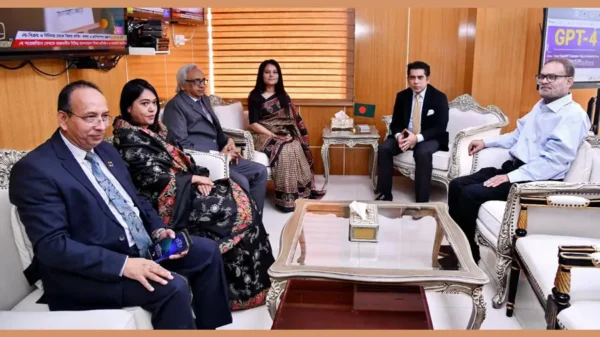
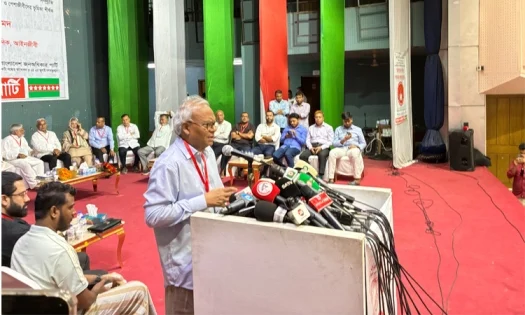
The initiative, a collaboration between the university’s International Center for Ocean Governance (ICOG-DU) and the First Institute of Oceanography (FIO) of China, officially commenced during a day-long seminar at Dhaka University on Tuesday.
Dhaka University Vice-Chancellor Prof ABM Obaidul Islam inaugurated the seminar as the chief guest.
The event, organised under the HEAT ATF Sub-Project 13025, featured a welcome address by ICOG Director Prof KM Azam Chowdhury. Other key speakers included the Dean of the Faculty of Earth and Environmental Sciences Prof Md Humayun Kabir, HEAT Project International Expert Tonya Astrid Capuano, and FIO Scientist Shumin Jiang.
Teachers, researchers, and students from various national universities attended the event alongside representatives from FIO and prominent national institutions such as the Ministry of Fisheries and Livestock, the Bangladesh Navy, and the Bangladesh Space Research and Remote Sensing Organization.
In his opening speech, Prof Obaidul emphasised the critical nature of international cooperation in oceanography, coastal environmental monitoring, and climate resilience.
“The ongoing scientific cooperation between Bangladesh and China has opened new possibilities in marine resource management, coastal risk management, and sustainable development,” Obaidul said.
He noted that the economy of Bangladesh, which centers on the Bay of Bengal, relies heavily on the sustainable management of marine resources to support coastal livelihoods, biodiversity conservation, and climate resilience.
“The successful deployment of GNSS buoys in the Andaman Sea and the ongoing initiative to deploy CNSS buoys in the Meghna Estuary will further strengthen Bangladesh’s ocean observation system,” Obaidul added, highlighting that these technologies will improve coastal management, maritime safety, disaster preparedness, climate adaptation, and sustainable blue economy planning.
Obaidul Islam praised the progress of the HEAT sub-project, noting that its approval through an international competition recognises the capability of local researchers, and expressed hope that the findings would guide future policy making.
During the technical session, FIO scientists presented papers on modern ocean observation technology, marine geohazards, and coastal environmental management.
Organisers also screened a documentary detailing the progress of the HEAT project, its modeling framework, and the GNSS Buoy Deployment Project.
The joint initiative combines cutting-edge field technology and numerical modeling. Researchers will use the Delft3D modeling system to trace climate change-related pollution, the spread of toxic substances, and pollution accumulation zones in coastal areas.
The project also aims to develop an interactive environmental database to conserve marine biodiversity.
It establishes a platform to assess the impacts of microplastics, heavy metals, and oil pollution to facilitate scientifically informed decisions.
The event concluded with an exchange of crests between ICOG-DU and FIO to symbolise their mutual cooperation.