





















Staff Reporter:
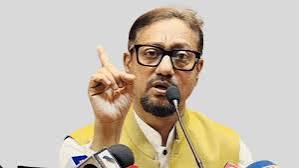
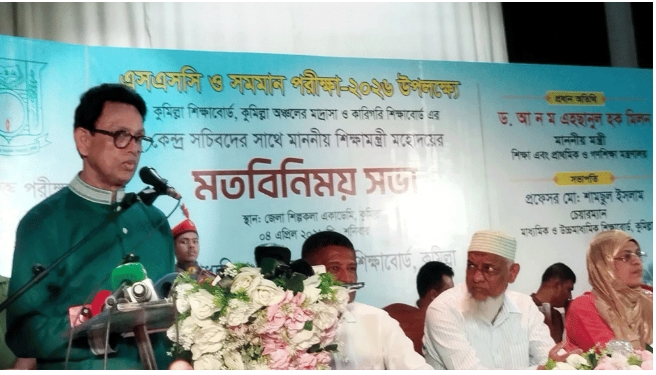
Education Minister Dr ANM Ehsanul Hoque Milon has said that the “date of birth of cheating” in Bangladesh’s education system refers back to 1972, adding that his ministry is determined to prevent any form of malpractice in public examinations.
“We had successfully stopped cheating between 2001 and 2006. This time, we will not allow cheating to happen again,” the minister said on Saturday while addressing an exchange meeting with centre secretaries of the Comilla Secondary and Higher Secondary Education Board, as well as officials from the technical and madrasa education boards of the region.
The event was held at the Cumilla Shilpakala Academy.
The minister said that teachers were responsible both for the beginning and the prevention of exam cheating. “Did we import teachers from abroad? No, we did not. Teachers themselves stopped it before. You should work in line with the government’s expectations, and we are with you,” he said.
He cited past examination results to illustrate his point, saying that the pass rate in Comilla dropped to 29% in 2002, rose to 33% in 2003, and reached 66% by 2006.
According to him, although pass rates initially declined when cheating was reduced, it proved that the education system was being corrected. He also claimed that during the interim government period, the pass rate had fallen to 63%, suggesting that the quality of education had suffered due to widespread cheating during that time.
The minister also expressed confidence that examination results would not collapse, saying the younger generation had demonstrated integrity and commitment to truth.
“The generation that helped liberate the country for a second time will not produce poor results,” he added.
Highlighting the changing nature of exam malpractice, the minister said cheating methods have now become digital. As a result, amendments have been made to the Public Examinations Act of 1980 to strengthen enforcement.
He warned that centre secretaries could face punishment even if cheating materials are found in examination centre restrooms, and action would also be taken against those supplying answers from outside.
Emphasising the importance of technical education, he said there is no alternative to vocational training for developing human resources. He also warned that institutions with a 0% pass rate could face strict scrutiny in the future, although they would be given a one-year grace period.
The minister instructed that all examination centres must have CCTV cameras, with backup power such as IPS systems to ensure uninterrupted monitoring. He also announced that coaching centres would be completely shut down in the future. Instead, teachers would be encouraged to provide additional academic support within their own institutions, even with extra charges if necessary, and staff members could also be compensated from these arrangements.
However, he stressed that teaching outside institutions would not be allowed.
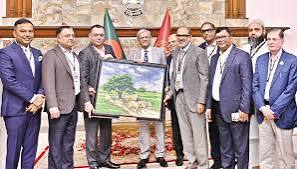
The welcome speech at the event was delivered by Comilla Education Board Chairman Md Shamsul Islam. Among the special guests were Members of Parliament Md Manirul Haque Chowdhury (Cumilla-6), Md Abul Kalam (Cumilla-9), Md Mobasher Alam Bhuiyan (Cumilla-10), Md Jashim Uddin (Cumilla-5), and Md Abdul Mannan (Brahmanbaria-5), along with Comilla City Corporation Administrator Md Yousuf Molla, Technical Education Board Chairman Ruhul Amin, Madrasa Education Board Chairman Mia Md Nurul Haque, Cumilla Deputy Commissioner Md Reza Hasan, and Superintendent of Police Md Anisuzzaman, among others.