





























Staff Reporter:
Yesterday marks Pahela Falgun, the first day of spring and the eleventh month of the Bangla calendar, a time that symbolizes renewal, vibrancy and cultural pride for Bangladeshis.
Spring, often described as the king of seasons, arrives with a message of fullness and new life.
For many years, Bangladeshis marked Pahela Falgun on February 13. However, in 2020, Bangla Acad-emy revised the Bangla calendar to align it with the Gregorian calendar, shifting Pahela Falgun to Feb-ruary 14 and effectively coinciding it with Valentine’s Day.
Bangladeshis are also celebrate Valentine’s Day with their loved ones, in step with the rest of the world, as a symbol of love and affection.
While the inclusion of Pahela Falgun has added a vibrant and festive dimension to the occasion, the day has, for the past few decades, been widely embraced, particularly by young people, as an essential mo-ment for celebration.
After the harshness of winter fades, nature adorns itself anew.
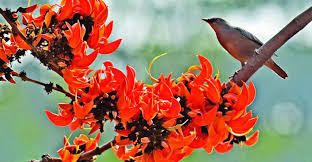
Fresh leaves sprout on trees, flower buds bloom, birds fill the air with song, and the breeze carries a soft floral fragrance.
This revival is felt not only in nature but also in the human spirit, drawing people into celebration and festivity.
The tradition of celebrating the Pahela Falgun in Bangladesh started in the Bengali calendar year 1401.
Since then, the Jatiya Bawshonto Utsab Udyapan Parishad has been celebrating Pahela Falgun regularly with jovial cultural festivity at the Bakultala of Charukala (Dhaka University Faculty of Fine Art) in the morning.
Since then, the day has grown into a major cultural occasion, with people dressing in shades of yellow and orange, participating in music, poetry and art to welcome spring.
The name “Falgun” is believed to have originated from the star Phalguni. Historically, around 1500 BC, both lunar and solar calendars were followed, and Falgun was considered a full-moon month. The organ-ised celebration of Pahela Falgun began more visibly in the 1950s and 1960s, when people in what is now Bangladesh embraced Bengali cultural practices, including Rabindra Sangeet, as a way of distin-guishing themselves from imposed Pakistani cultural norms.
Beyond its cultural richness, Falgun carries deep political and historical significance.
The red hues of shimul and krishnachura flowers recall the sacrifices of the martyrs of February 1952, when Rafiq, Safiq, Barkat and Salam gave their lives for the Bangla language.
Their blood-stained path ultimately led to Bangladesh’s independence, making Falgun not only a month of beauty and renewal, but also one of resistance and remembrance.
As the country welcomes spring yesterday, Pahela Falgun stands as a celebration of nature, culture and the enduring spirit of the Bengali people.