






























Staff Reporter:
National Citizen Party (NCP) convener Nahid Islam has warned that the people of Bangladesh are desperate for real change, and without it, elections, uprisings, or the Consensus Commission—nothing will deliver results. If meaningful reforms are not made, he said, the youth will once again take to the streets.
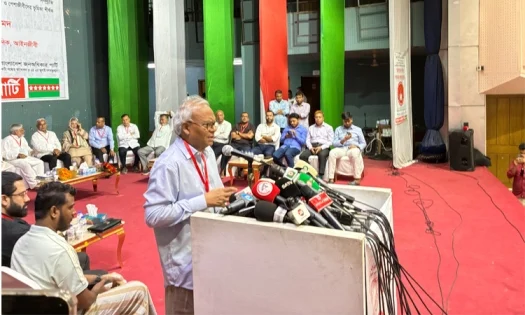
He issued the warning during the launch of the University Teachers’ Forum held at Bangla Academy in the capital on Friday (7 November).
Nahid Islam said the “fascist structure” of the old regime remains firmly intact, and that is why even after the consensus process, political forces are still failing to reach a consensus. “Fascism cannot be uprooted without changing the mindset of individuals and society,” he said.
Responding to debates over a note of dissent on the July Charter, the NCP convener said, “There will be no such thing as a note of dissent in the July Charter. Whatever consensus has been reached—people will decide the rest. If the public demands something, it must be implemented.”
He added that the country is heading toward elections based on the July Charter’s legal framework and that the movement will continue with the spirit of the mass uprising.
Nahid stressed that the next parliament and its reform council must represent youth, teachers, women, minority communities, and professionals from all spheres of society. “This is how the July Charter will be brought to life,” he said.
He reiterated that the immediate national demand is a public referendum, and insisted that the authority under the July Charter must be entrusted to Dr. Muhammad Yunus.
Nahid opined that all groups who participated in the July uprising have every right to sit in the next parliament. That parliament should form a reform council tasked with drafting a new constitution, where teachers must have significant representation. “The National Citizen Party will ensure it,” he added.
Extending thanks to teachers for their role in the July uprising, Nahid slammed the previous ruling system where, for 16 years, promotions in universities were handed out purely based on political loyalty, turning campuses into political outposts. “The fascist structure still survives in Bangladesh. Without changing personal and social consciousness, fascism cannot be wiped out.”
He warned that unemployment will not end unless the education sector is overhauled from the ground up. “If we cannot reform the education system, the state cannot be rebuilt,” he said.
Nahid also accused the former government of utter failure in delivering promised reforms to the education system. “They failed—and we will continue the fight,” he declared.