


























Staff Reporter:
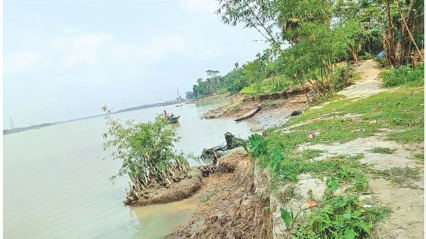
River erosion has intensified along 38 rivers across Barishal district, threatening homes, businesses, roads, croplands and other public infrastructure in several areas. According to the Barishal Water Development Board (WDB), around 60 kilometres of riverbanks along 38 rivers in the district are currently vulnerable to erosion, with severe erosion reported along 20–25 kilometres.
The Meghna, Tentulia, Kirtankhola, Arial Khan, Sandhya and Sugandha rivers are among those causing the most damage. In Mehendiganj, erosion along the Meghna and Tentulia has taken a serious turn as at least 41 houses and around 30 shops in Chargopalpur and Alimabad unions were washed away within five days, according to local residents.
Several other areas, including Char Mithua, Darirchar Khajuria, Adarsh Nagar, Andarmanik, Jahangalia and Dakshin Ulania, are also facing the threat of erosion.
In Babuganj, erosion by the Sandhya, Sugandha and Arial Khan rivers has damaged more than 200 structures, including houses, roads, embankments, educational institutions, mosques, cemeteries and businesses.
Mirganj and nearby villages remain particularly vulnerable, with residents in some areas facing the threat of displacement. In Barisal Sadar, erosion continues in Charbaria, Charmonai and Shayestabad. Hundreds of families have been affected, while residents of Lamchari village in Char Baria said they have been losing land to the river for around 15 years.
“The river has taken everything. Now there is no land left. We are forced to live on other people’s land on rent,” said Rafiq Majhi, a resident of Lamchari. Another resident, Jabbar Pyada, said, “I saw my house being submerged before my eyes.”
The WDB has placed geo-bags at several vulnerable points as part of its emergency response. However, residents said many of the bags are washed away by strong currents and heavy river flows. Md Jabed Iqbal, executive engineer of the Barishal WDB, said erosion was occurring along around 60 kilometres of riverbanks in the district due to the ongoing rainy season.
“The intensity of erosion is highest along 20–25 kilometres. Geo-dumping activities are being carried out in these areas as part of our emergency response,” he said.