




























Staff Reporter:
The Japanese Sub Working Group yesterday submitted its technical and financial proposals to operate and maintain the Third Terminal of Hazrat Shahjalal International Airport (HSIA), mov-ing the flagship aviation project closer to operation.
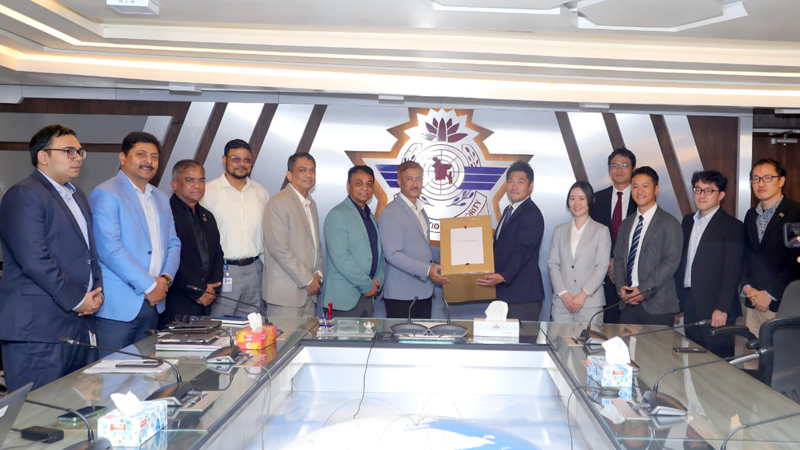
Masahiro Hirai, on behalf of the Japanese group, handed over the proposals to Civil Aviation Authority of Bangladesh (CAAB) Chairman Air Vice Marshal Md Mostafa Mahmood Siddiq at the CAAB headquarters here, according to a CAAB press release.
CAAB members and representatives of the Japanese delegation were present during the submis-sion.
The Japanese consortium submitted separate documents containing its technical and financial proposals for undertaking the Operation and Maintenance (O&M) of the terminal.
The proposals will now undergo scrutiny by an RFP Evaluation Committee constituted by the Ministry of Civil Aviation and Tourism following the prescribed procedures.
The committee comprises CAAB’s Member (Administration) and Member (Operations and Plan-ning), along with representatives from the Ministry of Finance, Ministry of Civil Aviation and Tourism, Prime Minister’s Office, Public Private Partnership (PPP) Authority and Roads and Highways Department.
Under the evaluation process, the technical proposal will be assessed first, followed by scrutiny of the financial proposal.
Following the evaluation, necessary discussions and negotiations will be held with the Japanese side.
Upon successful completion of the negotiations, the date for signing the agreement will be final-ised in accordance with the stipulated procedures, the release said.
The Third Terminal is one of Bangladesh’s largest and most significant aviation infrastructure projects and is expected to substantially enhance the capacity and service standards of the coun-try’s principal international gateway.
CAAB said the terminal, equipped with modern technology and designed to provide internation-al standard passenger services, is expected to play an important role in strengthening Bangla-desh’s aviation sector through efficient operational management.