

























Staff Reporter:
Justice Md Abdul Mannan, who was appointed in the High Court (HC) during the Yunus-led interim government, has been relieved of judicial duties as a recent incident linked to him has raised questions about ethics and public confidence in the judiciary.
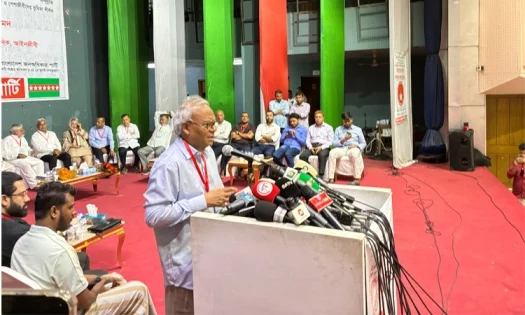
The viral video emerged from an event held on 3 April at the Central Medical College auditorium in Cumilla. Justice Mannan attended the event, and he allegedly behaved in an inappropriate manner there. He reportedly invoked his judicial identity to issue threats and was involved in a verbal altercation.
Recently, Chief Justice Zubayer Rahman Chowdhury reconstituted 63 HC benches upon the resumption of court proceedings after the vacation. Justice Mannan has not been assigned to any judicial work since 19 April. The Supreme Court sources have confirmed the matter on Thursday.
Justice Mannan has been kept away from any bench in the higher court without any mention of specific reasons. It is believed that the chief justice has taken the decision in view of the incident captured in the widely circulated video.
The footage shows Justice Mannan leaving the venue under police escort following an altercation with members of the public during the Apex Bangladesh board of directors’ election.
Legal analysts said that the incident has raised questions about judicial ethics and public confidence in the judiciary. Judges are expected to avoid situations that may undermine the dignity, impartiality, and independence of the office.
This action against the HC judge follows a separate incident in October 2024, where 12 High Court judges were relieved of judicial functions and denied benches following student protests demanding the removal of judges deemed allies of the previous regime.
Justice Md Abdul Mannan, a native of Jhenaidah, joined the judiciary on 25 April 1994 as an assistant judge. He was appointed an additional judge of the High Court Division of the Supreme Court on 9 October 2024 during the interim government led by Prof Muhammad Yunus, and was later confirmed as a permanent judge.
On the same date, 23 individuals were appointed as additional judges of the High Court. The appointments were effective from the date of oath-taking and were made for a term not exceeding two years.