


































Staff reporter:
Law, Justice and Parliamentary Affairs Minister Md Asaduzzaman yesterday said the government wants to further strengthen public trust in the country’s judicial system by reinforcing people’s confidence in the delivery of justice and restoring an environment of trust.
“More than 46 lakh cases are pending across the country, and disposing of this huge backlog with only 2,300 judges is a formidable challenge,” the minister said, stressing the need for judicial activism and the deployment of proactive judges in districts with heavy caseloads to expedite case disposal.
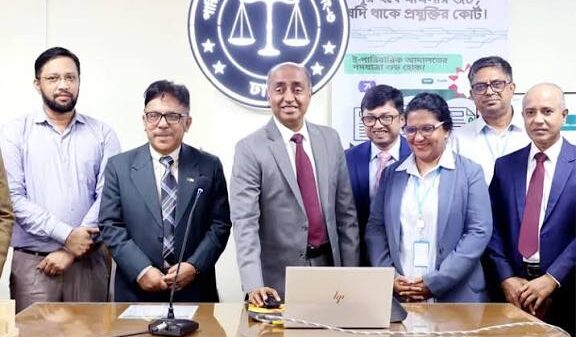
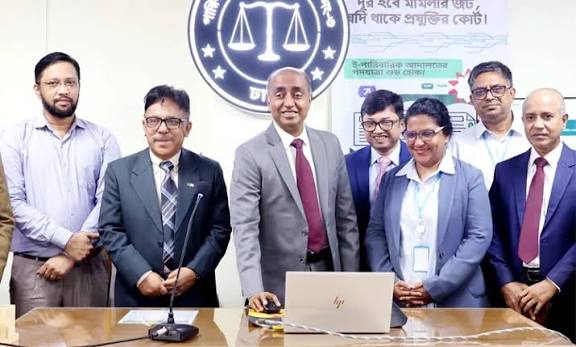
He made the remarks while inaugurating a new E-Family Court and the country’s first E-Family Appeal Court at the conference room of the Chief Metropolitan Magistrate Court Building.
The law minister further said the government was receiving reports that courts in some places operated for only two to three hours a day. Lawyers also reported that judges in some courts arrived at 11 am and finished their work by 1:30 pm or 2 pm.
He said the government would arrange for judicial officers who wanted a comfortable job by posting them to places where they could ‘work at ease’.
“Young judicial officers are smarter and more advanced than their time. I hope they will further advance the use of artificial intelligence (AI) in the judicial system. I also urge journalists to inform us of any irregularities they notice in court premises or any suggestions they have for improvement. Our doors are open to them, and we will warmly welcome their feedback,” Md Asaduzzaman added.
The law minister said the government was considering digitising the process of recording statements and ensuring the appearance of accused persons in court, as permitted under existing law. Bringing accused persons from prisons to courts on scheduled dates required extensive movement, vehicles and security arrangements, keeping an entire sector engaged in the process from morning until night.
He said the International Crimes Tribunal had already introduced a digital attendance system on a pilot basis for some accused. Under the system, the accused would remain in prison while the court observed them remotely, the relevant officials confirmed their attendance, and the court formally verified it digitally.
The law minister said the government had consulted various sectors and incorporated their views and recommendations into the Human Rights Commission Act and the law concerning enforced disappearances.
Referring to amendments to the Cyber Security Act, formerly known as the Digital Security Act, he said the government had emphasised the need for broader public consultation, given the law’s close links to the public and freedom of expression.
As a result, the proposed amendments were opened for public consultation to gather opinions from all quarters. The minister said arguments both for and against the law had emerged, while the international community was also discussing the issue with the government, which was considering every aspect.
Law and Justice Division Secretary Liaquet Ali Molla, Supreme Court Registrar General Mohammad Habibur Rahman Siddiquee, Dhaka District and Sessions Judge Md Rafikul Islam, and Dhaka Bar Association President Anwar Zahid Bhuiyan, among others, were present at the event.