
























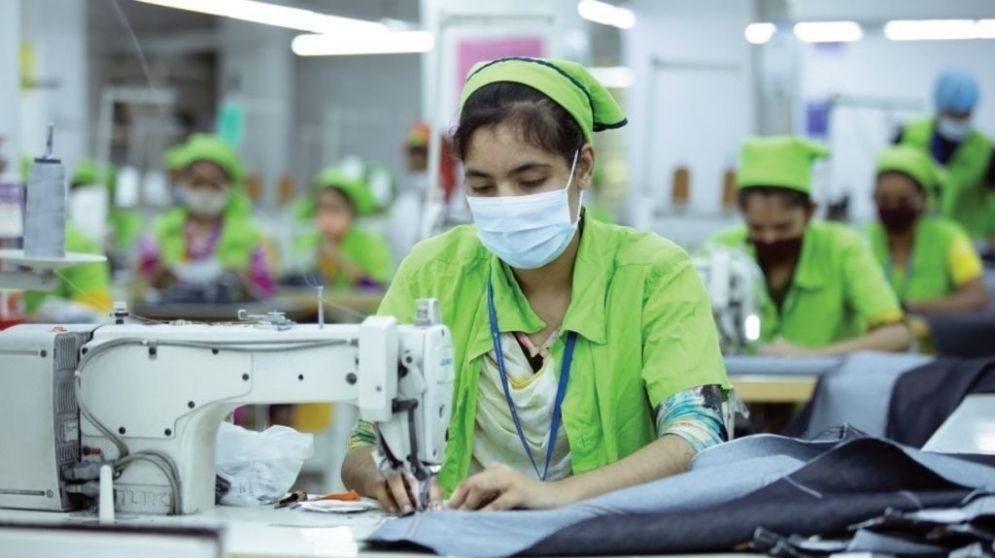
Bangladesh’s ready-made garment (RMG) sector staged a notable recovery in the April-June quarter of the fiscal 2025-26, with export earnings reaching US$10.10 billion.
However, the sector continues to face mounting challenges from rising production costs, energy constraints, labour issues, exchange-rate movements and intensifying competition in the global apparel market, according to a recent Bangladesh Bank report.
RMG export earnings stood at $10,098.29 million in the fourth quarter of FY26, up from $9,197.80 million in the previous quarter and 10.78% higher than the $9,115.63 million recorded in the same quarter of FY25.
The quarterly rebound reflected improved consumer demand, expanded production and progress in meeting international compliance requirements amid a changing global trade environment.
However, the report cautioned that the recovery does not mean the sector is free from pressure.
Exchange-rate movements, rising domestic production costs, energy supply constraints, labour issues and changing international trade conditions continue to affect the competitiveness of Bangladeshi apparel exporters.
Fluctuations in orders from major export destinations and changes in demand between knitwear and woven garments have also influenced quarterly performance.
Major markets remain crucial
Bangladesh’s RMG exports remain heavily dependent on a small number of major international markets.
During April-June, the United States, Germany, the United Kingdom, Spain, the Netherlands, France, Italy, Canada and Belgium were the nine leading destinations, according to BB data.
RMG exports to these nine markets amounted to $7,239.51 million, accounting for 89.61% of total RMG export earnings. Earnings from these destinations increased 11.15% from the previous quarter and 10.54% year-on-year.
The nine markets recorded total export earnings of $8,078.69 million across all products during the quarter.
The report said both knitwear and woven garments recorded growth on both a quarter-on-quarter and year-on-year basis, indicating a broad-based improvement in export performance.
Knitwear accounted for 47.60%, while woven garments accounted for 42.01% of RMG exports to these destinations.
Although gross RMG exports increased, net export earnings were considerably lower after accounting for imported raw materials. RMG net exports stood at $6,228.53 million, equivalent to 61.68% of gross RMG exports.
The gap between gross and net export earnings highlights the sector’s continued dependence on imported raw materials and inputs, making the industry vulnerable to changes in global input prices, exchange rates and import costs.
RMG remains the backbone of exports
Despite the challenges, the garment sector continues to dominate Bangladesh’s export economy. During FY26, total RMG export earnings reached $38,969.72 million, registering a modest 0.96% year-on-year growth over FY25, according to BB data.
The sector contributed 7.82% to Bangladesh’s nominal GDP in FY26, demonstrating its continuing importance to economic activity, foreign exchange earnings and employment.
The report identified rising production costs and increasing competition from other garment-exporting countries as major threats to Bangladesh’s future export performance. Persistent global economic uncertainty and geopolitical tensions could also affect consumer demand and international apparel orders.
For Bangladeshi manufacturers, higher costs can weaken the price advantage that has traditionally supported the country’s position in the global apparel market.
At the same time, changes in exchange rates, energy availability and labour conditions can increase operating costs and create uncertainty for exporters.
The sector is also exposed to shifts in global consumer preferences. Changes in demand between knitwear and woven products and fluctuations in orders from major markets can have a direct impact on factories and export earnings.
Despite these challenges, the report assessed the near-term outlook for Bangladesh’s RMG industry as moderately positive, supported by global apparel demand, the country’s competitive position in international markets and continued improvements in sustainability and compliance standards.
However, maintaining growth will require the industry to move beyond dependence on a limited number of markets and conventional products.
The report emphasised export diversification, value-added production and enhanced productivity as crucial to sustaining growth and strengthening the sector’s resilience.
The report suggests that the challenge for Bangladesh is no longer simply to increase garment exports, but to remain competitive while producing higher-value products, improving productivity, diversifying export markets and maintaining international sustainability and compliance standards.