











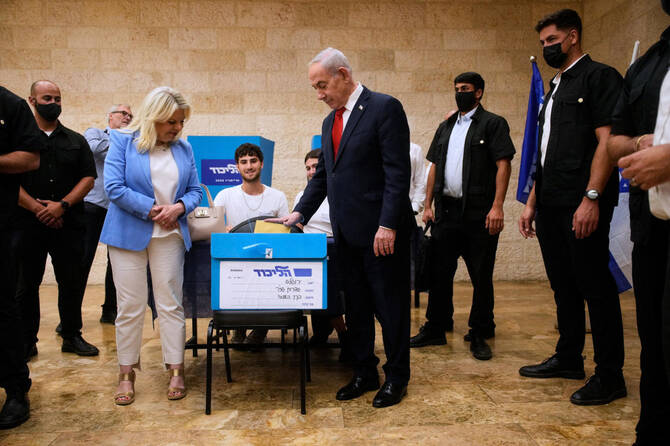
Likud members voted Monday to choose their candidates for Israel’s October 27 general election, in which the right-wing party of Prime Minister Benjamin Netanyahu faces a tight race.
Netanyahu is Israel’s longest-serving premier but now finds himself in a weakened position. He attempted controversial judicial reforms and since Hamas’s October 7 attack has pursued war across the Middle East.
Polls predict Likud’s number of parliamentary seats could fall from 32 to as low as 22.
Monday’s primary voting saw Likud’s 140,000 members choose their candidates. Netanyahu has set aside around 10 spots for people of his own choosing, which local media described as an at-tempt to ensure he is surrounded by loyalists.
Longtime Likud member Avi, 30, condemned the move. “That’s not democratic… They’ve de-stroyed Likud” he said, adding that he had not decided who would get his vote at the general election.
Elie Cohen, a 79-year-old member of Likud’s central committee, dismissed such criticism and said he was convinced that Netanyahu was “entrusted with a divine mission”.
Narkis Alfi and Brouria Ben Yehouda, two staunch Likud activists, said they supported Netanya-hu’s management of the party.
“My impression is that the prime minister’s goal is to bring about real change here, to bring in new people, young people, who are very motivated,” Alfi told AFP.
Ben Yehouda described Likud as a diverse party.
“There are Mizrahi Jews, Ashkenazis, Jews, Arabs, everyone. That’s what’s good about Likud: there’s a bit of everything, from every background,” she said.
Many religious Jews, including the ultra-Orthodox and mostly men, were also present at the primary voting. Many of them had joined Likud in recent years to defend their interests.
Party officials, including several ministers, were campaigning alongside candidates unknown to voters — smiling, hugging and taking selfies.
Outgoing lawmaker Amit Halevy told AFP he would have preferred “fewer reserved spots” for Netanyahu to choose, but added: “In the end, the vast majority will be chosen through the pri-maries, and that’s what matters.”
At the end of voting, turnout stood at 53 percent, an increase of 10 percent compared to the last primary in 2022, according to a party statement.
The figure is being closely watched as a barometer of mobilisation ahead of the general election.–Net