















Staff Reporter:
When 18-year-old Yasir Sarker left his home in Shonir Akhra on the morning of 5 August 2024, he promised his mother he would return by noon.
His mother, Bilkis Akter, pleaded with him not to join the protests. Yasir reassured her before walking out.
He never came back.
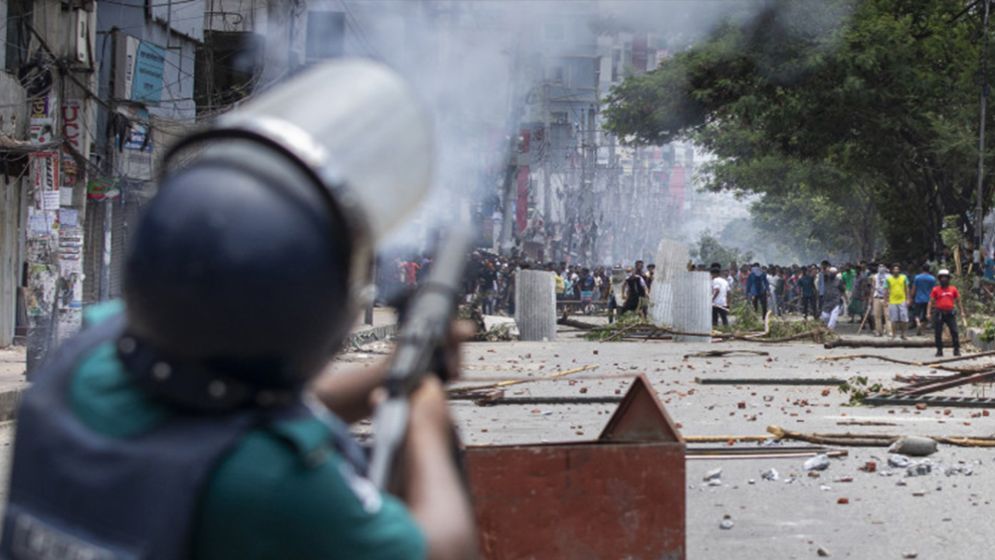
Around 3pm, as he was heading towards Ganobhaban through Kutubkhali in Jatrabari, police allegedly opened fire on protesters.
According to his family, around 100-150 police personnel, accompanied by Awami League activists, fired on the crowd.
Yasir was hit by three bullets – two in the chest and one in the lower abdomen.
As evening approached and he failed to return, his family began a frantic search.
His sister, 20-year-old Hafsa Bushra, posted his photograph on Facebook, hoping someone had seen him.
At about 10pm, someone from Dhaka Medical College Hospital (DMCH) sent her a blood-soaked photograph asking whether it was her brother.
It was.
Within moments, hope gave way to heartbreak.
Yasir’s story is one of many that came to symbolise Jatrabari, where some of the fiercest resistance – and bloodiest violence – unfolded during the July student uprising.
A bastion of resistance
Usually one of Dhaka’s busiest transport gateways, linking the capital with the Dhaka-Chattogram highway, Jatrabari was transformed into one of the movement’s strongest resistance hubs.
The intensity of the clashes was reflected in the death toll. International Crimes Tribunal Chief Prosecutor Md Aminul Islam said at least 85 people were killed in Jatrabari during the uprising, including between 50 and 55 on 5 August alone.
Students, joined by local residents, turned the area into a key battleground against security forces.
Frontline protester Maksudur Rahman said residents now observe 17 July as “Jatrabari Resistance Day”.
“We call 17 July Jatrabari Resistance Day because the resistance that began here that day remained unbroken for a long time. We believe the movement would not have advanced so quickly without this resistance,” he said.
According to Maksudur, the movement gained momentum from the afternoon of 17 July as clashes erupted between protesters and police. Demonstrators set fire to two toll plazas on the Mayor Hanif Flyover in the Kajla area, marking the beginning of sustained resistance.
Highway under protesters’ control
From 17 July until the afternoon of 21 July, protesters effectively controlled Jatrabari.
Students and local residents maintained barricades while fires burned at several points along the highway, bringing all vehicular movement to a standstill.
Another frontline protester, Ibrahim, said Jatrabari’s strategic importance stemmed from its location on the Dhaka-Chattogram highway.
He said protesters blocked the road with buses, trucks and other vehicles, reinforcing barricades with bricks, bamboo and construction materials.
Schools and colleges led the movement
Unlike many other parts of Dhaka, where university students spearheaded the protests, Jatrabari’s resistance was initially driven largely by students from schools, colleges and madrasas.
“People came onto the streets on their own after witnessing the bloodshed involving their friends, relatives and neighbours,” Ibrahim said.
Maksudur attributed the prolonged resistance partly to the area’s geography.
During security operations, protesters would retreat into surrounding neighbourhoods before regrouping on the main road once the situation eased.
He claimed repeated crackdowns failed to bring the area fully under the control of security forces for an extended period because protesters continually returned after each operation.
Students involved in the movement said thousands from Jatrabari Ideal School and College, Mahbub Mollah College, Donia College, Bornomala Adarsha High School and College, Shamsul Haque Khan School and College, Shyampur College, Samiran Nessa School, Muradpur School and Bright School and College joined the highway blockade.
Community stood beside protesters
Participants said the resistance was sustained not only by students but also by ordinary residents.
Locals carried the injured to hospitals, distributed drinking water, opened their homes as safe shelters and arranged food and basic medical assistance.
Women supplied water and other essentials from rooftops as clashes raged below.
For the people of Jatrabari, the days of July and August remain etched in memory as a time of extraordinary courage and devastating loss.
The highway that normally carries thousands of vehicles each day became a symbol of defiance, where students and ordinary residents stood shoulder to shoulder and paid one of the highest prices during one of the most defining chapters in Bangladesh’s recent history.