























Staff Reporter:
State Minister for Health and Family Welfare Dr MA Muhit yesterday said that 1,600 doctors are are receiving specialized training simultaneously in 40 districts to ensure quality dengue treatment across the country and prevent deaths caused by errors in clinical management.
“Efforts are underway to bring the death rate from dengue down to zero by equipping doctors with science-based training, ensuring that no dengue patient dies due to lack of treatment or errors in management,” he said.
Doctors are being trained in accordance with clinical management standards for dengue, which will help reduce the death rate and save many lives, the state minister added.
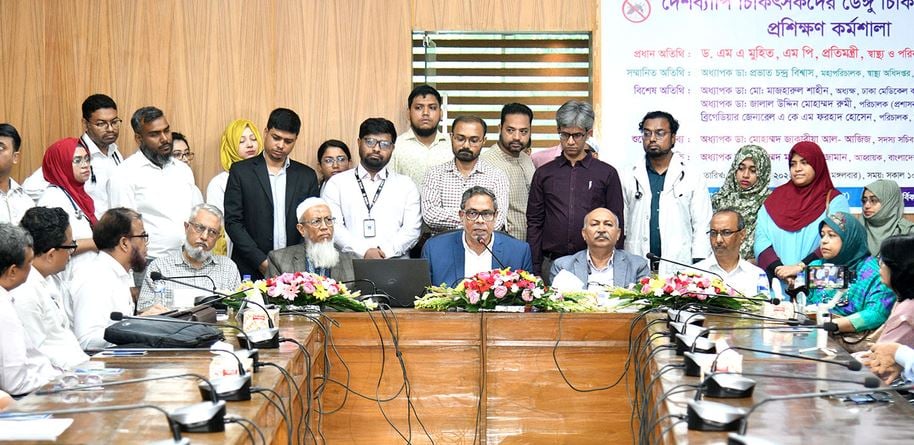
Dr Muhit made the remarks as the chief guest at the inaugural session of the daylong emergency training program, titled ‘Training of Doctors on Clinical Management of Dengue’ at Dhaka Medical College here, said a press release.
The emergency training program has been launched across the country under the direction of the state minister. Specialist professors and doctors of the Bangladesh Society of Medicine are conduct-ing the training program across the country.
Principals of medical colleges, civil surgeons and representatives of doctors from grassroots-level facilities and specialized hospitals across the country joined the program both virtually and in per-son.
Highlighting the success of the healthcare sector and the relentless efforts of doctors, Dr Muhit said 63,627 dengue patients have so far been hospitalized during the current dengue season.
Despite limited facilities and heavy patient pressure, he said, 59,083 patients have already recov-ered and returned home, while around 4,300 patients are currently undergoing treatment.
“Despite the rise in the number of patients, doctors and health workers across the country are suc-cessfully treating around 99 percent of those infected and sending them back to their families,” the state minister said.
Dr Muhit, also an international public health expert, said an effective healthcare system cannot be built solely on emotions or unplanned decisions.
“Initiatives are now being taken to address crises in a coordinated manner by collecting epidemio-logical data, formulating science-based plans, and providing training to doctors,” he said.
Emphasizing the professional dignity and social protection of doctors and other health workers, the state minister said indiscriminate media trials against healthcare professionals are not acceptable.
“There should be no distance between service providers and the people. The desired reforms in the health system must be advanced while ensuring due respect for doctors,” he said.
It was informed at the program that around 350 senior doctors had earlier received Training of Trainers (ToT) under an initiative of the Bangladesh Society of Medicine.
Those senior doctors are now conducting simultaneous training for 1,600 doctors in 40 districts across the country.