



















Staff Reporter:
The government is exploring alternative sources of financing to restructure the country’s financ-ing framework, while foreign investors are showing growing interest in Bangladesh’s capital market, Finance and Planning Minister Amir Khosru Mahmud Chowdhury said yeterday.
He said several major foreign fund managers, including US investment banking giants JPMorgan and Goldman Sachs, have expressed interest in investing in Bangladesh.
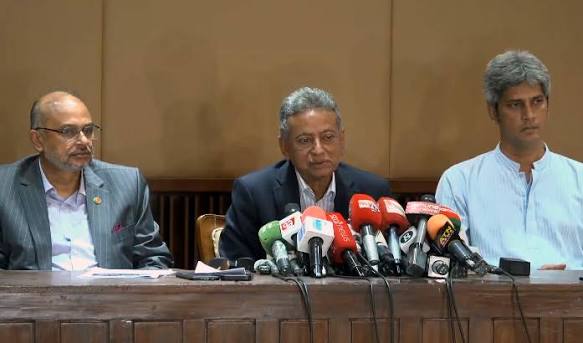
The finance minister made the remarks while speaking at length at a luncheon titled “Building Investors Confidence: From Policy Reform to Effective Implementation,” organized by the American Chamber of Commerce in Bangladesh (AmCham) at a city hotel yesterday.
He said Bangladesh’s industrial and commercial sectors have become overly dependent on the conventional banking system, which is not appropriate for a modern economy.
“Commercial banks generally collect short-term deposits but provide long-term loans. Large-scale investment should instead be financed through the capital market,” he said.
The minister said the global financial architecture is changing rapidly, while Bangladesh remains heavily dependent on bank financing. “We are therefore exploring alternative sources of financ-ing and working to redesign the financing structure for the future,” he said.
He said the government is looking beyond traditional development partners such as the World Bank, International Monetary Fund (IMF) and Asian Development Bank (ADB) to explore new sources of financing.
“Alternative financing will be crucial to achieving our goal of building a $1 trillion economy by 2034,” he said.
The minister said many countries have long been using a wide range of financial instruments, but Bangladesh has failed to utilize them effectively. He said the process of change has now begun.
He noted that bond financing in many cases costs less than bank borrowing and that equity-based financing also offers significant opportunities. “Such instruments could help reduce the overall cost of financing,” he added.
Expressing optimism about the capital market, Khosru said reforms at the Bangladesh Securities and Exchange Commission (BSEC) and changes to capital-market regulations have encouraged both domestic and foreign investors to consider listing and investing in the market.
“We are receiving positive responses from foreign fund managers. It is not just one or two; sev-eral major fund managers have shown interest in investing in Bangladesh,” he said.
He added that major US investment banks, including JPMorgan and Goldman Sachs, had also expressed interest in coming to Bangladesh.
However, the minister said the country’s market capitalization remains small and more compa-nies need to be encouraged to list on the stock exchanges.
Highlighting the challenges facing the banking sector, Khosru said the country’s financial sector, particularly many banks, is currently facing a crisis, with capital shortages compounded by mon-ey laundering and high levels of non-performing loans.
Many depositors are unable to withdraw their money, while businesses are facing difficulties in securing working capital, opening letters of credit and accessing other forms of financing, he said.
“Recapitalization of banks is therefore extremely important,” he said, adding that the govern-ment can’t meet all banks’ capital shortfalls by allocating huge amounts from the national budg-et.
The government is instead trying to address the problem through a combination of government support, rescue funds and other recapitalization measures, he added.
On tax reform, Khosru said businesses have long complained about complexity, bureaucratic harassment and corruption in the tax system.
He said initiatives have been taken to make the system more efficient, noting that Bangladesh’s tax-to-GDP ratio remains very low compared with both global and regional standards.
The government has decided to split the National Board of Revenue (NBR) into two separate entities, with one responsible for policymaking and the other for implementation, he said.
“In the past, the same people were involved in both tax policy formulation and implementation. Under the new system, tax policy formulation will be entrusted to experts,” he said.
The minister said the broader impact of tax policies on businesses, taxpayers, revenue mobiliza-tion and consumption would be taken into consideration during policymaking.
He also said the government is working to fully automate the tax system despite facing re-sistance. Once implemented, taxpayers will be able to complete the entire process—from filing income tax returns to receiving refunds—online and more quickly.
On deregulation, Khosru said Bangladesh has developed a culture of excessive regulation over the years. A taskforce has been formed to oversee efforts to reduce unnecessary regulatory bar-riers, he added.
A website would soon be launched where businesses and citizens could report obstacles to de-regulation, he said, adding that the government would monitor the complaints on a daily basis.
Regarding export-oriented industries, the finance minister said entrepreneurs investing in ex-port-oriented industries beyond the ready-made garment sector would be provided bonded li-cences with duty-free facilities.
He said entrepreneurs bringing new export products would receive bonded warehouse, tax-free and, where necessary, back-to-back letter of credit facilities.
“Those who do not wish to use bonded warehouses would be able to receive similar facilities un-der bank guarantees,” he added.
Addressing energy challenges, Khosru said economic growth depends heavily on electricity and gas, although all existing problems in these sectors cannot be resolved immediately.
He said decisions have already been taken on floating LNG terminals, land-based storage facili-ties and other issues in the gas sector.
Although power generation has increased, transmission remains a major challenge, he said.
“The government is moving towards an integrated energy framework combining renewable en-ergy, gas and coal-based power,” he added.
Khosru also stressed the importance of strong internet connectivity for achieving the target of building a $1 trillion economy by 2034.
“Without strong internet connectivity, it is not possible to develop the digital economy and in-formation technology sector,” he said.
The finance minister acknowledged that the government could not claim that all problems had been resolved, but said it remained ready to engage with businesses to address their concerns.
“Any reasonable problem raised by the business community will be considered with due im-portance,” he said.
AmCham Bangladesh President Syed Mohammad Kamal and HSBC Bangladesh Chief Executive Officer Mohammad Mahbub ur Rahman, among others, also spoke at the event.