











The international rescue teams are packing up and heavy excavators are clearing rubble left by Venezuela’s earthquakes.
But for Raul Alvarado the search goes on.
Watching volunteers pick through the crushed remains of his 12-storey apartment building, Alvarado knows his mother, father and older brother are inside.
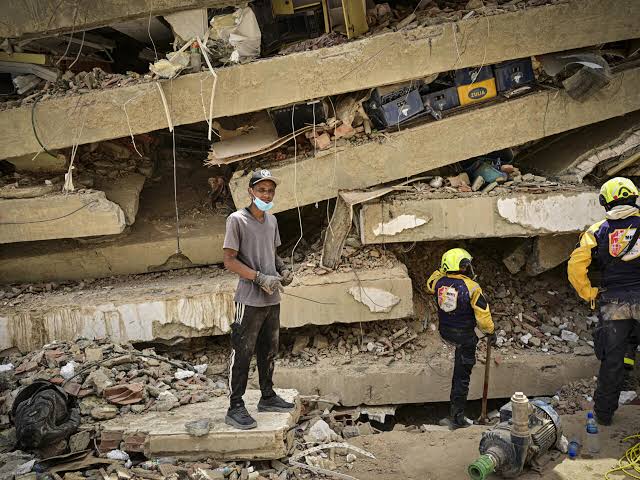
Their third-floor apartment now sits at eye level, crushed under piles of concertinaed concrete slabs from the OPP 26 building in coastal Caraballeda, one of the districts hardest hit by the quakes.
Deaths from the June 24 disaster have crept past 3,500, but for families like Alvarado’s there is still the race to find the tens of thousands reported missing.
Twelve days after the quakes hit, time is running short.
Diggers are already clearing parts of the OPP complex, shaking the ruins even as volunteers and families continue to burrow for the bodies of loved ones.
“They were together the three of them, hugging,” said Alvarado of the last moment he saw his family.
He managed to pull himself out of the rubble because he was in a different room.
“This building was full. My neighbor had five grandchildren, all them are trapped in there.”
Stuck in the layers of floors, a microwave, mattresses and crates of beer are the only signs of the build-ing’s previous life.
Nearby a large excavator slams its shovel into another building’s remains.
The UN has estimated that as many as 50,000 people could be missing in one of Latin America’s worst earthquake disasters. The government has yet to give any estimate.
But the OPP complex is only one among the nearly 200 buildings that were destroyed or collapsed when the 7.2 and 7.5 magnitude quakes struck. Most of those are in the epicentre, the coastal La Guaira area.
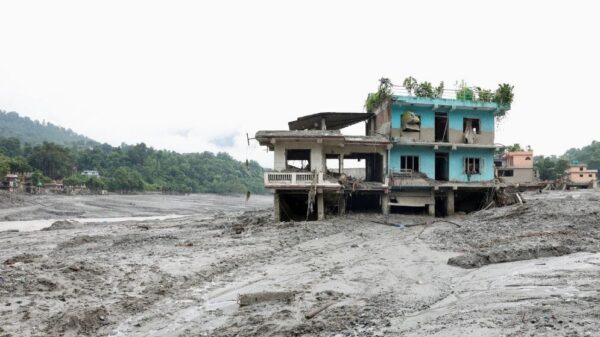
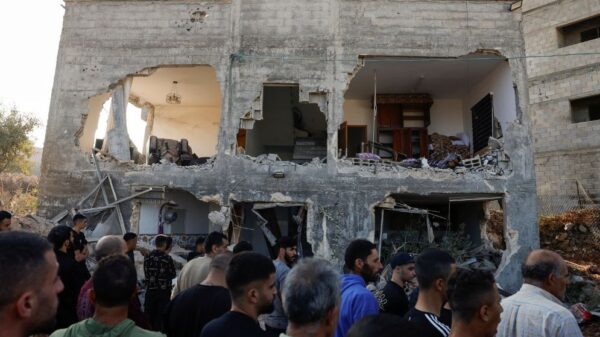
All around Alvarado’s building lies destruction. Some apartment blocks are stripped of their facades. Others are fully collapsed, floor slabs stuck together. Others simply disappeared into rubble.
Dozens of families of the missing wait on top of mountains of debris where the OPP buildings once stood. Volunteers and firefighters dig small tunnels through the concrete floors to reach lower apart-ments.
Some sit under makeshift shelters, others use picks and drills powered by generators. Inside one hole, the body of young girl lays trapped, covered in lime.
Alny Pacheco, a volunteer working at one tunnel, said since the earthquakes they had taken out 12 dead. On Monday, his team had found another.
– Missing online –
After the quakes, online registries appeared to help find the missing. One, “Venezuela Earthquake Dis-appeared” has more than 30,000 names still unaccounted for. Another “Venezuela Looks for You” has registered 25,000 already found, and another 18,100 unaccounted for.
“The high number of people reported missing on online platforms remains horrifyingly credible,” Jens Laerke, deputy spokesperson for the UN Office for the Coordination of Humanitarian Affairs (OCHA), told AFP.
“That does not mean all are under the rubble, but it illustrates the scale of the distress facing families.”
National Assembly President Jorge Rodriguez has said images from drones, registries and family ac-counts showed an estimated 30,000 people were in La Guaira. Around 19,800 escaped or had been res-cued, he said.
He did not refer to the whereabouts of the other approximately 10,000, or say whether that figure in-cluded confirmed deaths.
Professor Katsu Goda, of Western University’s earth sciences department in Canada, said a combination of the unusual double quake and the potential vulnerability of reinforced concrete materials may have contributed to the high number of missing.
The first earthquake would have weakened many structures, while the second shock likely caused addi-tional collapses before occupants could escape. As a result, damage was amplified, he told AFP.
“When reinforced-concrete buildings collapse, they often generate enormous volumes of dense rubble that are extremely difficult and dangerous to search,” he said.
“In some cases, progressive or ‘pancake’ collapses can trap occupants within compressed layers of debris, making rescue operations and victim identification particularly challenging.”
The scale of the disaster, as in Haiti in 2010, also meant many people could be classified as missing for a while, he said.
For Daniela Alvarez — who is looking for her sister, nieces and brother-in-law in an OPP block — time is running out.
“How can they be looking to demolish everything without knowing if people are still under there?” she said.
“Our families will come out in pieces.”–Net