






















Staff Reporter:
Before most children even open their school bags, fourth-grader Dipu Babu is already on the move. He crosses nearly half an hour of a remote river island in Bogura’s Sariakandi upazila every day for attending his school, then boards a boat to cross the restless Jamuna, then walks another 20 minutes on the far bank before he reaches his school–assuming the weather cooperates. When storms hit, the boats stop, and so does school.
The building he’s walking toward doesn’t really exist anymore, either.
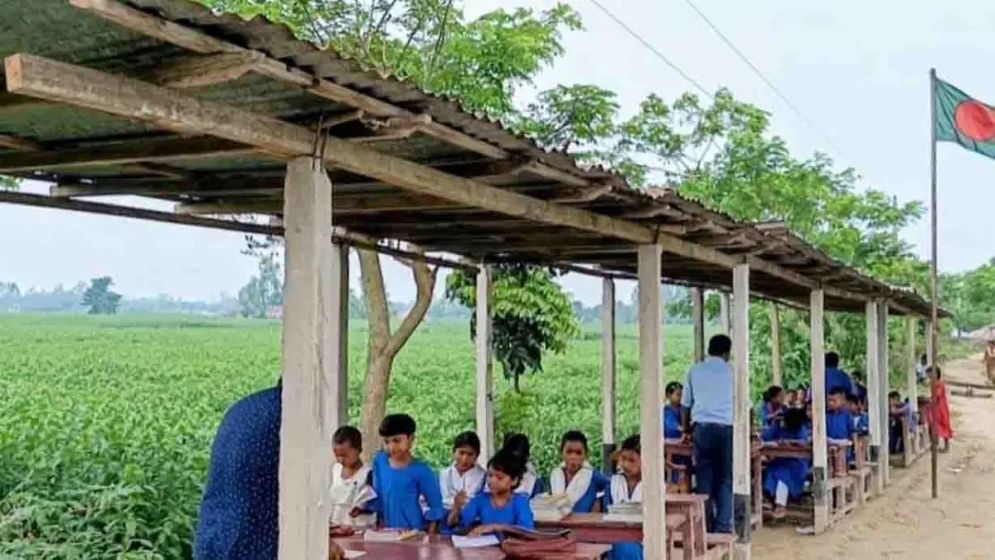
Chakratinath Government Primary School, 107 years old and established in 1919, now runs out of a tin shed bolted onto a flood-control embankment. The Jamuna swallowed the original campus for the sixth time on 16 May this year. A century-old school pushed off its own land by a river that keeps coming back for more–it’s one image, but it captures a crisis in Bangladeshi education that almost nobody talks about. Not climate change exactly. Not river erosion exactly. Educational injustice, plain and simple.
When schools vanish, so do futures
Over the last two decades, Bangladesh has poured resources into primary education–enrollment is up, gender parity has improved, access has widened almost everywhere. But travel along the riverbanks and those national success stories start to look thin. In places like Sariakandi, getting kids to want to attend school was never really the problem. Keeping a school standing long enough for them to attend is.
Chakratinath once served 482 students. It now has 74, and river erosion is the reason, full stop. Behind that number is a whole chain of loss: families lose homes, then they migrate, then communities come apart, then children either switch schools or quietly stop attending altogether. Nobody failed here–not the teachers, not the parents. The school didn’t disappear because anyone gave up on it. It disappeared because the ground under the community washed away.
A climate problem that shows up in classrooms
Most conversations about climate change in Bangladesh circle back to flooded crops, wrecked roads, displaced households, broken embankments. Classrooms rarely make the list. But education is quietly becoming one of the casualties nobody’s counting.
Kids in these eroded communities aren’t just losing a building. They’re losing routine, learning time, focus, confidence–and for some, eventually, school itself. At Chakratinath, teachers now run two shifts because the shelter can’t hold everyone at once. When it rains, water comes through the tin roof, books get soaked, and class just stops; kids wait it out crammed into nearby houses until the weather clears. There’s no curriculum built for that kind of constant interruption, and no exam measures the learning lost while a class waits out a storm.
What erosion actually costs
Usually river erosion gets measured in hectares of lost farmland or households displaced. Useful numbers, but they miss what economists sometimes call intergenerational loss.
Once a school becomes hard to reach, dropout risk climbs fast. Kids in char areas already face long, difficult commutes–an hour or more of walking and river crossings before class even starts. Understandably, parents get nervous about sending young children across dangerous water during monsoon season, so some kids just stay home. Some start working instead. Some never come back to school at all.
That’s not a today problem. Lower educational attainment feeds into lower lifetime earnings, weaker local economies, less mobility down the line. River erosion, in other words, is manufacturing poverty a generation ahead of schedule.
Teachers are the ones actually holding this together
What’s most striking about Chakratinath isn’t some institutional resilience story. It’s personal sacrifice. Teachers pooled their own money to build the temporary classroom rather than wait on government funding–which says a lot about their commitment, and raises an uncomfortable question at the same time: should teachers be footing the bill for emergency school infrastructure? Should a vulnerable community’s education depend on how generous its teachers happen to be? These are people worth admiring. They shouldn’t have to double as public policy.
Not just one school’s problem
Chakratinath is only the clearest example. Across Sariakandi and neighboring Sonatola, other schools face the same threat–some have already relocated, some run out of temporary structures, some just sit on the edge, watching erosion creep closer every rainy season. Roughly 1,500 families have reportedly left several villages in recent years because of this. As communities shrink, so do the schools that serve them.
Education planners typically project classroom demand off birth rates and population growth. Along the Jamuna, they need to start tracking something else, too: where the river is heading next.
Planning has to catch up to the climate
Bangladesh already treats climate change as a national development issue. It’s time the education system caught up. That means getting ahead of school collapses instead of scrambling after them–identifying erosion hotspots before disaster hits, treating relocation as a planned move rather than an emergency response, and building temporary classrooms that are actually designed to withstand conditions rather than just improvised after the fact. Safe transport–boats, bridges, school hostels, whatever fits the terrain–needs to be part of the plan for riverine communities from the start. Protecting a child’s access to school deserves the same urgency as protecting an embankment. Both are protecting the future, just in different currencies.
The real question
The Jamuna has taken Chakratinath Government Primary School six times. A seventh feels less like a possibility than a matter of scheduling.
But the more pressing question isn’t whether another building goes under. It’s whether Bangladesh is willing to let another generation of riverbank children disappear from education right along with it. When a river takes land, governments rebuild the embankment. When it takes childhood, there’s no equivalent fix–no line item, no quick reconstruction. What’s washing away in Sariakandi isn’t brick or farmland. It’s opportunity. And opportunity, once it’s gone, is a lot harder to rebuild than a school.