












Staff Reporter:
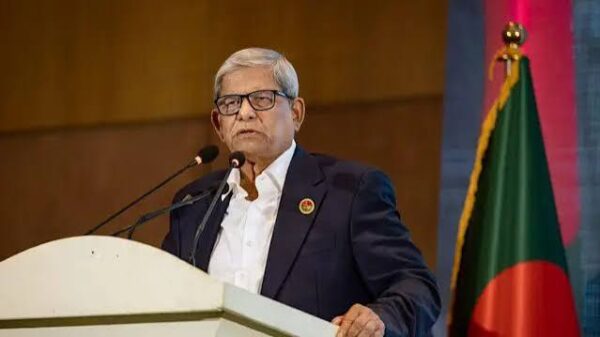
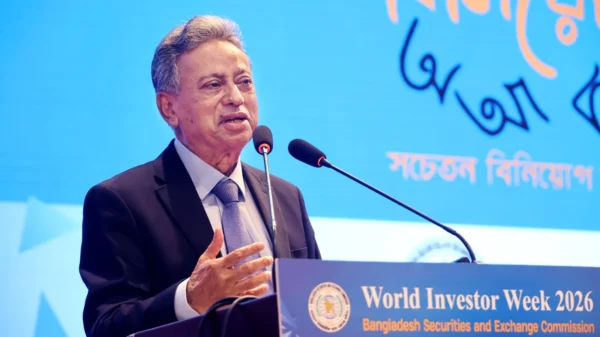
Finance and Planning Minister Amir Khasru Mahmud Chowdhury yesterday emphasized that Bangla-desh’s current readiness for Least Developed Country (LDC) graduation is incomplete, necessitating a strategic three-year window.
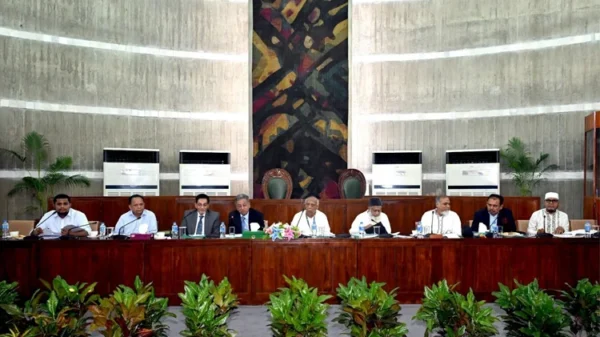
“A realistic transition requires urgent capacity building. The country needs some more time to effective-ly tackle the challenges of LDC graduation,” he made these remarks after a National Multi-stakeholder Consultation organized by the Economic Relations Division (ERD) in collaboration with UN-OHRLLS and the UN Resident Coordinator’s Office at the NEC Conference Room in the city.
Economic Relations Division (ERD), United Nations Office of the High Representative for the Least Developed Countries, Landlocked Developing Countries and Small Island Developing States (UN-OHRLLS) and the UN Resident Coordinator Office in Bangladesh jointly organized the event.
The Finance Minister characterized the current economic landscape as a complex environment where the government is forced to operate in a firefighting mode to manage daily crises.
He noted that the administration is currently engaged in a critical salvage effort to rescue an economy where almost all major indicators are trending downward.
The Minister mentioned that the national treasury is currently facing several immediate challenges, in-cluding a focus on daily crisis management over long-term development, negative economic indicators, and continuous financial bleeding caused by heavy energy subsidies and high import dependency, along-side rising debt burdens and systemic weaknesses in financial management.
He observed that while energy prices have doubled in the United States and risen sharply in Sri Lanka, the Bangladesh government is currently attempting to keep prices relatively controlled.
However, he cautioned that the state cannot sustain this fiscal pressure indefinitely.
The Minister asserted that these principles provide the necessary framework for a transparent and resili-ent economic base.
He said that the national economic recovery strategy focuses on the three core pillars of capacity build-ing for indigenous growth, policy alignment with BNP manifesto principles to create a financial founda-tion, and achieving economic stability through a transition to long-term sustainable health.
The Minister emphasized that LDC graduation is not a fixed certainty but must be contingent upon eco-nomic health.
The government intends to utilize the available extension or suspension period-estimated at approximate-ly three years-to ensure the nation is truly prepared for the transition, he added.
“The plan is to strengthen fundamental economic indicators within this window of approximately three years. Only through the successful implementation of necessary reforms, skill development, and the achievement of genuine economic stability during this period will LDC graduation become a realistic and sustainable goal for the future,” he noted.
He reiterated that as an elected body, the government’s primary responsibility is to protect the public from sudden financial shocks.
He stressed that while the government is working to shield citizens from immediate inflationary pres-sure, it must take decisive, calculated steps to stop the bleeding of public funds to ensure the nation’s long-term financial survival.
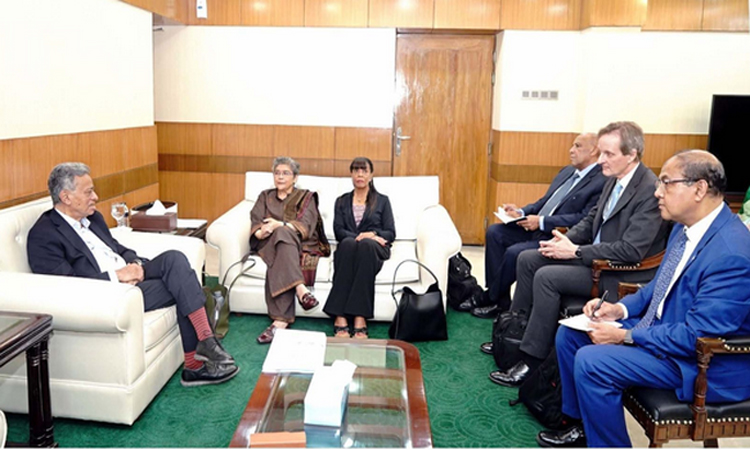
Commerce Minister Khandakar Abdul Muktadir, Adviser of the Ministry of Finance and Ministry of Planning Dr. Rashed Al Mahmud Titumir, Under-Secretary-General and High Representative of the UN-OHRLLS Rabab Fatima and State Minister for Planning Md. Zonayed Abdur Rahim Saki were present as special guests.
ERD Secretary Md. Shahriar Kader Siddiky chaired the event.
Member of the UN Committee for Development Policy (CDP) Taffere Tesfachew, Secretary of the Ministry of Commerce Mahbubur Rahman, President of Bangladesh Garment Manufacturers and Ex-porters Association (BGMEA) Mahmud Hasan Khan, Distinguished Fellow of CPD Dr. Mustafizur Rahman, UN Resident Coordinator a.i. in Bangladesh Ms. Carol Flore-Smereczniak, President of the Bangladesh Knitwear Manufacturers and Exporters Association (BKMEA) Mohammad Hatem, President of Footwear, Leathergoods and Accessories Exporters Association (FLAXA) Syed Nasim Manzur, Presi-dent of Bangladesh Association of Pharmaceutical Industries (BAPI) Abdul Muktadir, President of Dha-ka Chamber of Commerce & Industry (DCCI) Taskeen Ahmed, among others, spoke during the occa-sion. Director of UN-OHRLLS Mr. Roland Møllerus moderated the discussion session of the event.
Representative of private sector and CSOs in the meeting reiterated the demand for extending Bangla-desh’s preparatory period for LDC graduation by three years.
Representatives from various government ministries and divisions as well as representatives from the private sector, think tanks and civil society organizations participated in the workshop.