
















Staff Reporter:
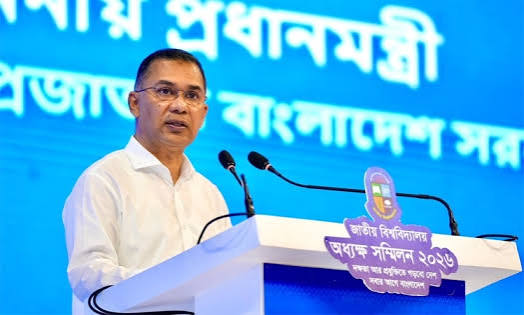
Prime Minister Tarique Rahman yesterday urged teachers to keep educational institutions free from factionalism and personal rivalry, saying political differences must not disrupt studies or student safety.
In this context, he also called for a modern, skills-based education system with student-centered, research-based teaching.
“Differences in political opinion and belief are natural in a democratic society. But teachers must remain alert and conscious so that such differences do not disrupt the learning environment, teaching activities, administrative discipline and the safety of students,” he said.
The Prime Minister was addressing the conference of the principals of National University (NU) as chief guest this morning at Shaheed Suhrawardy Indoor Stadium in Mirpur.
Principals of all 2,318 colleges affiliated with the National University attended the conference, with the theme “Building the country through skills and technology, Bangladesh first”.
Describing the role of a college head, the Prime Minister said a principal is not merely the administrative chief of an institution.
“A principal is the leader of the institution, its moral guide and one of the architects of the future generation. The overall progress of an institution depends largely on his or her merit, competence, decisions, prudence and foresight,” he said.
Recalling the contribution of late Begum Khaleda Zia, he said the former prime minister established the National University on October 21, 1992, to create higher education opportunities for people in both cities and villages.
“The number of colleges affiliated with the university is now nearly two and a half thousand. Although the number of colleges and students has increased since its establishment, we need self-criticism about how much the quality of education has actually improved,” he said.
Noting that the education system, like other sectors, suffered during the previous fascist regime, he said: “Now, in a fascism-free Bangladesh, everyone must work together to make the education system modern, quality-oriented and time-befitting.”
He said the government was taking necessary plans and steps toward this end, but principals must play a leading role in implementing them.
Stressing that there was no alternative to teacher training for building a modern, technology-based education system, Tarique Rahman said traditional teacher-centered education must be replaced.
“Instead of the prevailing teacher-centered education, student-centred and research-based teaching methods must be introduced. The ‘Training of Trainers’ program can play an effective role in this regard,” he said.
Warning against failure to adapt, he said: “If teachers and students cannot adjust to modern technology-based education, the number of certificate-holding educated people will rise every year, but unemployment will not fall.”
He identified the lack of practical and technical knowledge and skills alongside academic education as one of the main causes of unemployment among graduates.
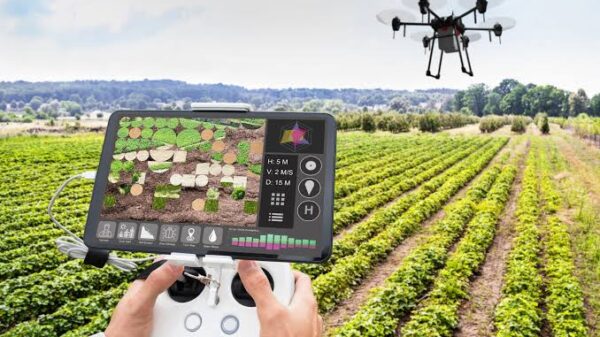
Urging higher education institutions to move beyond conventional approaches, the premier said artificial intelligence, robotics, big data, the Internet of Things, blockchain, automation, genetic engineering, cybersecurity and 5G were bringing radical changes to the future world of work.
“On one hand, many old professions are disappearing because of these technologies, and on the other, new fields of employment are emerging. In this reality, there is no alternative to building a technology-based, innovation-oriented, skills-based and employment-friendly education system,” he said.
Emphasising coordination between education and industry, he said: “Educational institutions will build the foundation of knowledge, and industry will turn that knowledge into real skills.”
He asked authorities to consider allowing skilled and experienced industry professionals to teach at colleges and universities as guest lecturers, and called on entrepreneurs to expand internship, industrial attachment and hands-on training opportunities for students.
He urged the Ministry of Education, the Directorate of Secondary and Higher Education, the Non-Government Teachers’ Registration and Certification Authority (NTRCA) and the NU authorities to take necessary initiatives to this end.
Colleges with suitable rooftop space should move to install solar power, he said.
He also urged teachers and students to jointly keep institutions, homes and surroundings clean and strengthen tree plantation drives, noting that nearly 200,000 trees had already been planted at educational institutions.
He called on every college to adopt a positive approach toward financially disadvantaged, marginalised and special-needs students.
About 40 lakh students study at the 2,318 affiliated colleges, accounting for around 70 percent of all higher education students in the country.
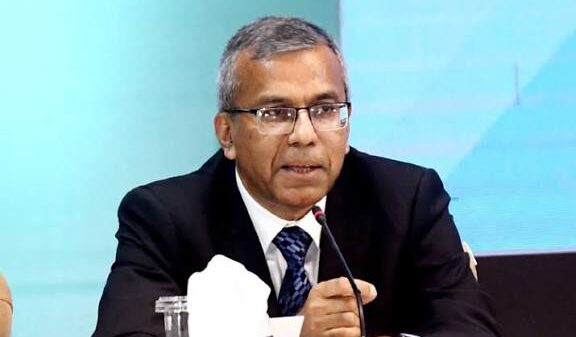
Education Minister Dr A N M Ehsanul Hoque Milon, Prime Minister’s Education Adviser Mahdi Amin and Senior Secretary of the Secondary and Higher Education Division Abdul Khaleque were present as special guests.
Chaired by NU VC Prof Dr ASM Amanullah, it was also addressed by Pro-Vice Chancellor Prof Dr Mohammad Ali Jinnah, NU Treasurer Prof Dr Md Nazmul Hossain, Bogura Government Azizul Haque College Principal Prof Md Mahfuzul Islam, Lalmatia Government Mahila College Principal Sultana Mahmuda Yasmin.