










Staff Reporter:
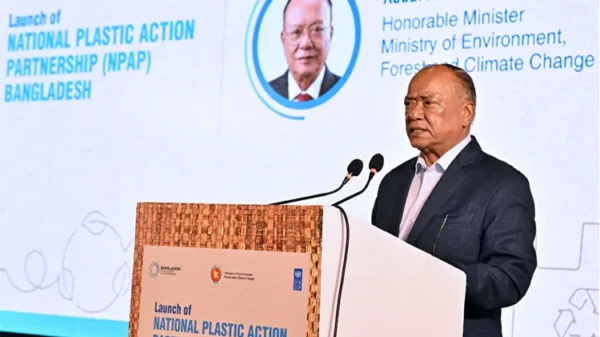
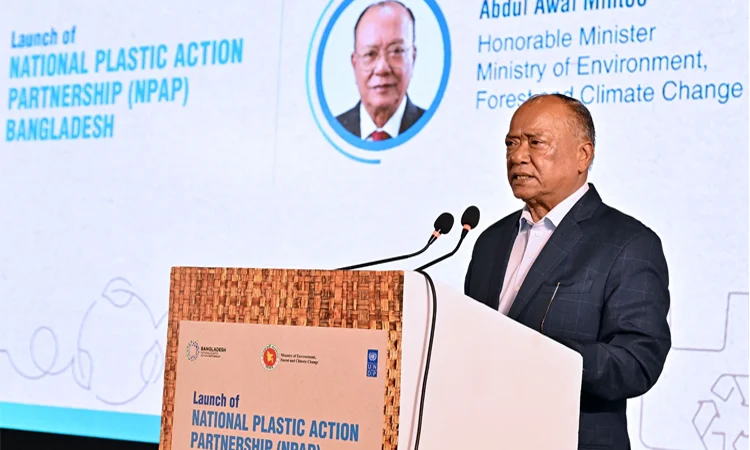
Environment, Forest and Climate Change Minister Abdul Awal Mintoo yesterday stressed taking an in-tegrated initiative to check plastic pollution.
He said the government, private sector, development partners, research institutions, civil society and waste management personnel must work collaboratively to curb plastic pollution.
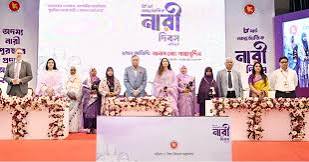
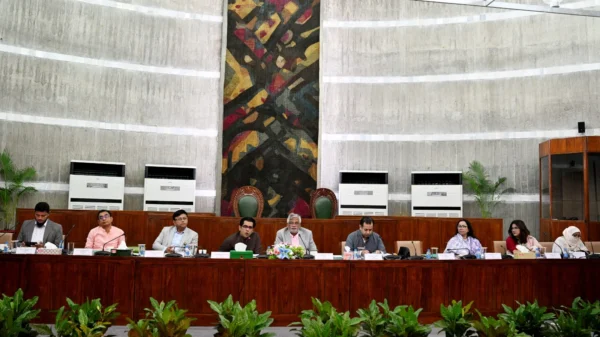
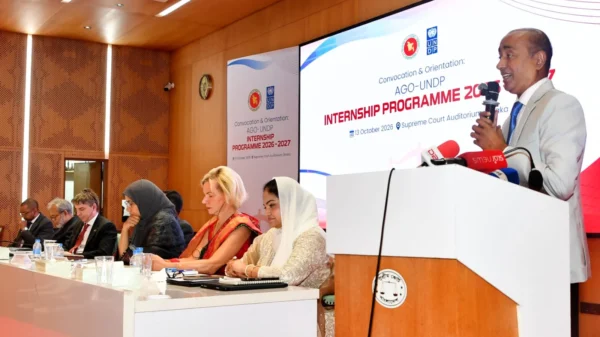
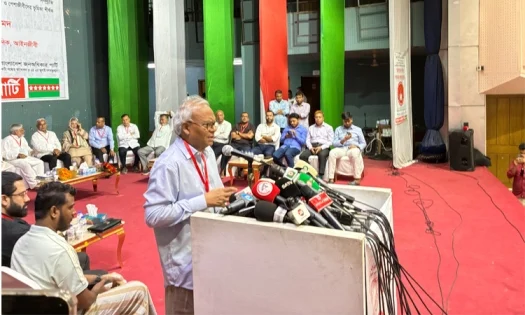
The environment minister made the remarks while speaking as the chief guest at the launching ceremony of the National Plastic Action Partnership (NPAP) Bangladesh held at a city hotel.
The event was jointly organised by the Ministry of Environment, Forest and Climate Change, UNDP Bangladesh and the World Economic Forum’s Global Plastic Action Partnership.
Mintoo emphasised the need to move towards a circular economy by reducing the use of unnecessary plastics, increasing reuse, and strengthening waste collection and recycling systems.
He said plastic pollution affects urban drainage systems, rivers, wetlands, coastal areas, public health, and ecosystems.
At the same time, the minister said, plastic is integral to production, trade, employment, and daily life, so addressing this issue requires considering the entire system – from production and consumption to waste
management.
Referring to the Extended Producer Responsibility (EPR) Guidelines, 2026 for plastic waste manage-ment, he said ensuring effective implementation is crucial to reaping the policy’s benefits.
To this end, reliable data, cooperation among producers, regulatory bodies, recyclers, and local authori-ties, as well as necessary infrastructure, transparency and accountability are required, he said.
Highlighting the role of NPAP Bangladesh, Mintoo said the platform would help connect fragmented initiatives, bridge the gap between policy and implementation, link innovators with markets, and align investments with national priorities.
Stating that the government would lead the initiative, he called for the active participation of all relevant sectors and formally inaugurated the NPAP Bangladesh.
The minister urged business entities to come forward with practical solutions and investments.
He also called upon universities and research institutions to strengthen the evidence-base, asked devel-opment partners to align their cooperation with national priorities, and encouraged financial institutions to explore investment opportunities within circular economy.
Speaking as a special guest, State Minister for Environment, Forest and Climate Change Shaikh Md Fa-ridul Islam said the success of NPAP should be evaluated based on results rather than the mere number of meetings held.
Director of World Economic Forum’s (WEF) Global Plastic Action Partnership (GPAP) Cl‚mence Schmid delivered a video message.
Presided over by Dr Fahmida Khanam, Acting Secretary of the Ministry of Environment, Forest and Climate Change, the event was also attended, among others, by Additional Secretary Mohammad Navid Shafiullah, Department of Environment Additional Director General Mohammed Solaiman Haider, and UNDP Bangladesh Assistant Resident Representative Sardar M Asaduzzaman.