








Staff Reporter:
When Prime Minister Tarique Rahman addressed the United Nations General Assembly on 24 September 2026, he became the third member of his family to speak from the same podium, following Ziaur Rahman in 1980 and Khaleda Zia in 1993. Separated by forty-six years, the three appearances unfolded in markedly different international contexts: the Cold War and North–South economic tensions of 1980; the post-Cold War optimism of 1993; and the fragmented, conflict-ridden and contested multilateral order of 2026.
Read together, the addresses also correspond to three major political ruptures in Bangladesh, 1975, 1990 and 2024, followed by successive efforts to reconstruct representative government. Ziaur Rahman spoke amid post-1975 political and economic reconstruction; Khaleda Zia after the 1990 uprising and restoration of parliamentary government; and Tarique Rahman after the July–August 2024 uprising, transitional reforms and the February 2026 election. The international environment changed, but a fundamental political question persisted: how can moments of political opening be transformed into durable democratic institutions?
The argument, therefore, is not one of uninterrupted democratic achievement, but of an unfinished democratic struggle. Across three generations, the Zia family’s UN addresses reflect successive conceptions of Bangladesh’s democratic aspirations and the changing international circumstances in which those aspirations were advanced.
Ziaur Rahman: Democracy, development and sovereignty in the Cold War
Ziaur Rahman’s 26 August 1980 UN address came amid renewed Cold War tensions, the second oil shock, a weakening North–South dialogue and stalled efforts to establish a New International Economic Order (NIEO). Against this backdrop, his emphasis on development, self-reliance and economic sovereignty connected Bangladesh’s post-1975 reconstruction with the wider structural inequalities confronting developing states. His focus on food security, employment, agriculture, infrastructure, education and health reflected the priorities of an economically vulnerable country, while his assertion that “Our commitment to the democratic process will not be shaken” linked national reconstruction to political legitimacy.
That statement, however, should not be regarded as evidence that democratic consolidation had already been achieved. Rather, it expressed the government’s stated commitment to an emerging political order shaped by electoral politics within a military-dominated context. Zia used the UN platform to place Bangladesh’s post-1975 reconstruction within the broader North–South debate, connecting self-reliance, development, sovereignty and democracy. His democratic challenge in 1980 was principally one of political reconstruction: establishing a stable order while asserting Bangladesh’s developmental and sovereign interests within an unequal international system.
Khaleda Zia: Democracy and development in post-Cold War moment
Khaleda Zia’s 1 October 1993 UN address came in a transformed international environment after the end of the Cold War, when democracy, human rights and multilateral cooperation had gained renewed international legitimacy. Domestically, her appearance followed Bangladesh’s own political transition: the 1990 mass uprising ended Ershad’s military rule, the 1991 election restored electoral government, and the Twelfth Amendment reinstated the parliamentary system. Her central political challenge was therefore to turn the democratic opening into a durable parliamentary order. She presented democracy, human rights and development as mutually reinforcing, emphasising that sustainable development required political stability and democratic governance.
Yet the restoration of parliamentary government did not constitute democratic consolidation. Subsequent polarization, electoral disputes, parliamentary boycotts and institutional weaknesses demonstrated the continuing fragility of the political settlement. Khaleda Zia’s address is particularly significant because she explicitly recalled Ziaur Rahman’s 1980 UN speech and his call for “bold and imaginative action,” establishing a direct intellectual continuity between the two appearances. The international vocabulary had shifted from Cold War self-reliance and the NIEO toward democracy, human rights and development, but the underlying institutional question remained: how can a political opening become a durable democratic order?
Tarique Rahman: From democratic transition to democratic reconstruction
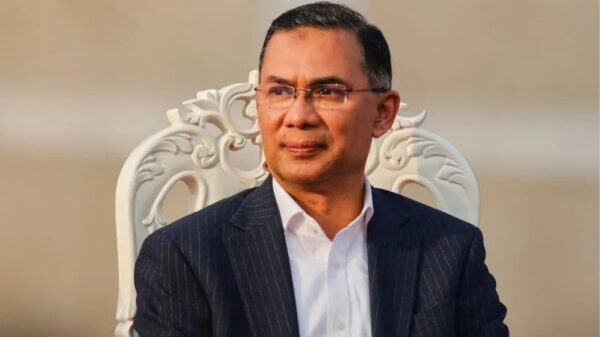
Tarique Rahman’s 24 September 2026 address represents a third stage in this sequence, set against an international environment defined by major-power rivalry, war, humanitarian crises, economic interdependence, technological transformation and uncertainty over the effectiveness of multilateral institutions. His references to Ziaur Rahman and Khaleda Zia establish continuity across the three UN appearances, while his invocation of the July–August 2024 uprising and the February 2026 election places the address within a new domestic political opening. Bangladesh’s experience is thus positioned within the wider debate over the future of multilateralism and institutional capacity.
More significantly, Tarique Rahman defines democracy beyond electoral competition, linking it to political and economic empowerment, accountability, equality and human dignity. His assertion that “a state can never become strong by keeping its citizens powerless” also connects his argument with the two earlier addresses. Ziaur Rahman associated democracy with reconstruction, sovereignty and development; Khaleda Zia with parliamentary government, development and human rights; while Tarique frames the task as democratic reconstruction and institutional renewal. The stated “Recovery, Restoration and Reconstruction” agenda accordingly presents social protection, education, employment, women’s participation and technological access as components of a broader effort to translate political change into more inclusive institutions.
From the New International Economic Order to artificial intelligence, the vocabulary of Bangladesh’s international advocacy has changed, while its underlying developmental concern remains consistent. Ziaur Rahman emphasised economic self-reliance and structural inequality; Khaleda Zia framed development through democracy, human rights and international cooperation; and Tarique Rahman extends these concerns into the technological age, warning against an emerging “AI divide” and calling for technology transfer, skills development and equitable access. Across these periods, the central concern remains how developing states can secure greater autonomy and opportunity within an unequal international system.
A similar continuity appears in the language of peace, sovereignty and multilateralism. From Ziaur Rahman’s emphasis on sovereignty, peace and development during the Cold War, through Khaleda Zia’s post-Cold War focus on cooperation and human rights, to Tarique Rahman’s advocacy of dialogue, sovereign equality, disarmament and the United Nations, Bangladesh’s international outlook has consistently connected national interests with multilateral engagement. His references to Bangladesh’s peacekeeping contribution and role in the Peacebuilding Commission further position the country as an active participant in collective peacebuilding.
The Rohingya crisis, climate change, migration and LDC graduation extend this developmental diplomacy to contemporary global challenges. Tarique Rahman combines Myanmar’s responsibility for resolving the Rohingya crisis with the need for sustained international humanitarian support, while framing climate vulnerability, migration and development financing as questions of international equity. The challenges have evolved — from oil, food security and economic dependency in 1980 to climate risk, displacement and technological inequality in 2026 — but the underlying question persists: how can a developing sovereign state preserve political autonomy, democratic legitimacy and equitable development within an international system marked by unequal resources and power?
Three political ruptures, three democratic openings, one unfinished democratic struggle
The three UN appearances correspond to three major political ruptures in Bangladesh—1975, 1990 and 2024—and reveal an evolving Zia-family conception of democratic reconstruction. Ziaur Rahman’s 1980 address associated political reconstruction with sovereignty, development and self-reliance after the upheaval of 1975. Khaleda Zia’s 1993 address shifted the focus toward consolidating parliamentary democracy following the 1990 uprising and restoration of parliamentary government. Tarique Rahman’s 2026 address presents a further evolution toward institutional renewal, emphasising citizen empowerment, accountability, inclusion and economic participation after the political rupture of 2024. The trajectory thus moves from political reconstruction to parliamentary consolidation and democratic renewal.
Yet this trajectory is best understood as a continuing political project rather than a completed democratic achievement. The three addresses mark successive attempts to translate political rupture into representative government and, ultimately, durable institutions. Their significance lies not simply in three members of the Zia family appearing before the same UN institution, but in how each articulated a distinct democratic imperative in response to a different national crisis. The unresolved challenge remains institutional: whether political openings can produce credible elections, accountable government, effective checks and balances, fundamental rights and peaceful transfers of power.
In that sense, 1975, 1990 and 2024 represent three political ruptures; 1980, 1993 and 2026 three democratic openings; and the Zia family’s three UN appearances three successive articulations of an unfinished democratic struggle. The changing international orders altered the vocabulary, but the underlying commitment expressed across the three addresses remained the pursuit of a more representative and institutionally grounded democratic order for Bangladesh.